"Piecing Me Together" Is a Gorgeous Collage of Self-Discovery
As a Black non-binary queer person, my life and my identity are made up of a variety of experiences and influences.
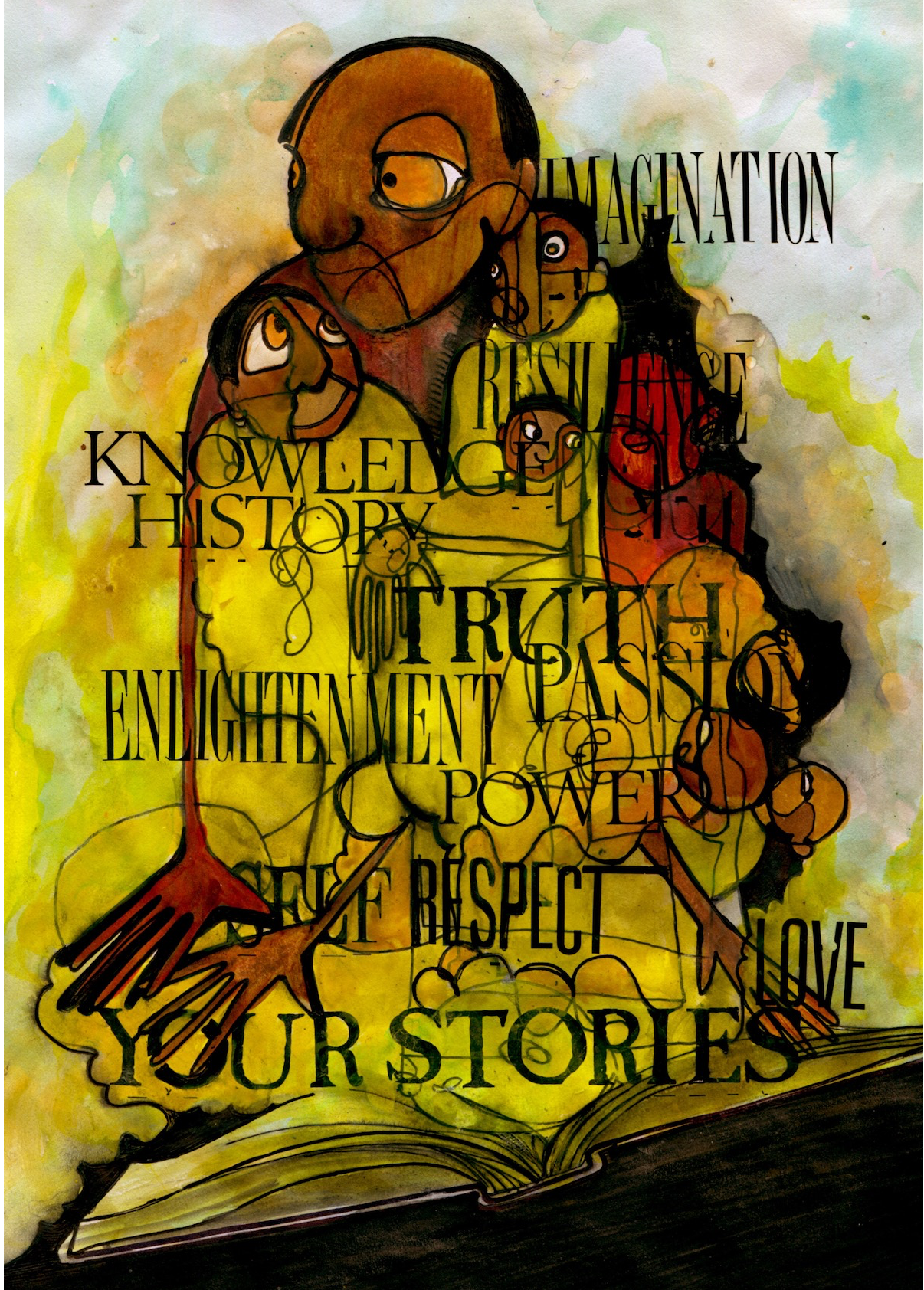
While I’m more aware of who I am now, there was a time when I just wasn’t sure about it. In Renée Watson’s beautifully written book Piecing Me Together, the main character Jade creates a collage out of her experiences to figure out who she wants to be.
The world told me that Black people couldn’t be geeky, sensitive, and emotionally vulnerable.
Out of all the ideals of respectability and success, the idea that a Black person needs to escape their “bad” living areas in order to be successful is one of the most pervasive. It is this idea that Jade combats in the book, even as she yearns to travel the world and speak Spanish. Since Jade sees the beauty in her friends, family, and her neighborhood of North Portland, she uses those influences to define herself in a positive way and make her collage art.
Not only does Jade undergo self-discovery with her present day life, but she also uses historical influences from the past. One day, she learns about York, a Black slave who went on the Lewis and Clark expedition. She is drawn to his story because he was having his identity and personal story defined for him. Jade also learns about Black collagists like Romare Bearden and Mickalene Thomas later in the book. Once Jade finally starts speaking up with her actual voice and honing her artistic voice, she combines the past and present for her art and for herself.
Once Jade finally starts speaking up with her actual voice and honing her artistic voice, she combines the past and present for her art and for herself.
Through lived experience, art, and learned history, Jade literally puts together the pieces of who she feels she wants to be. As an artist, daughter, student, and more, Jade refuses to let others define who she is as a Black girl. Jade is a collage worth seeing in all its pieces and glory, and that makes her story powerful.
The Afro YA promotes black young adult authors and YA books with black characters, especially those that influence Pennington, an aspiring YA author who believes that black YA readers need diverse books, creators, and stories so that they don’t have to search for their experiences like she did.
Latonya Pennington is a poet and freelance pop culture critic. Their freelance work can also be found at PRIDE, Wear Your Voice magazine, and Black Sci-fi. As a poet, they have been published in Fiyah Lit magazine, Scribes of Nyota, and Argot magazine among others.
Listening to these mentors, I feel like I can prove the negative stereotypes about girls like me wrong. But when I leave? It happens again. The shattering. And this makes me wonder if a Black girl’s life is being stitched together & coming undone.
These lines made me really connect to Jade as a character because of similar feelings I had as a teenager. Like Jade, I felt like my identity was constantly under attack by expectations and preconceived notions of what a Black person is like. The world told me that Black people couldn’t be geeky, sensitive, and emotionally vulnerable so I learned to hate myself. Unlike Jade, I didn’t have the self-worth and knowledge to define myself on my own terms until my twenties.
Another thought about Jade defining herself on her own terms is expressed when she says,
Sometimes I just want to be comfortable in this skin, this body. Want to cock my head back and laugh loud and free, all my teeth showing, and not be told I’m too rowdy, too ghetto…. Sometimes I just want to let my tongue speak the way it pleases, let it be untamed and not bound by rules.
While I have never been called too rowdy or ghetto by others, these lines made me think of the ideals of respectability that I unconsciously learned from various media and my own parents. I was expected to go to college, get the right degree, and not be too influenced by “bad” Black kids who got pregnant in high school or dropped out. At one point, I was also told not to watch too much BET and not speak too much slang when I wasn’t around my peers.
The world told me that Black people couldn’t be geeky, sensitive, and emotionally vulnerable.
Out of all the ideals of respectability and success, the idea that a Black person needs to escape their “bad” living areas in order to be successful is one of the most pervasive. It is this idea that Jade combats in the book, even as she yearns to travel the world and speak Spanish. Since Jade sees the beauty in her friends, family, and her neighborhood of North Portland, she uses those influences to define herself in a positive way and make her collage art.
Not only does Jade undergo self-discovery with her present day life, but she also uses historical influences from the past. One day, she learns about York, a Black slave who went on the Lewis and Clark expedition. She is drawn to his story because he was having his identity and personal story defined for him. Jade also learns about Black collagists like Romare Bearden and Mickalene Thomas later in the book. Once Jade finally starts speaking up with her actual voice and honing her artistic voice, she combines the past and present for her art and for herself.
Once Jade finally starts speaking up with her actual voice and honing her artistic voice, she combines the past and present for her art and for herself.
Through lived experience, art, and learned history, Jade literally puts together the pieces of who she feels she wants to be. As an artist, daughter, student, and more, Jade refuses to let others define who she is as a Black girl. Jade is a collage worth seeing in all its pieces and glory, and that makes her story powerful.
The Afro YA promotes black young adult authors and YA books with black characters, especially those that influence Pennington, an aspiring YA author who believes that black YA readers need diverse books, creators, and stories so that they don’t have to search for their experiences like she did.
Latonya Pennington is a poet and freelance pop culture critic. Their freelance work can also be found at PRIDE, Wear Your Voice magazine, and Black Sci-fi. As a poet, they have been published in Fiyah Lit magazine, Scribes of Nyota, and Argot magazine among others.
Listening to these mentors, I feel like I can prove the negative stereotypes about girls like me wrong. But when I leave? It happens again. The shattering. And this makes me wonder if a Black girl’s life is being stitched together & coming undone.
These lines made me really connect to Jade as a character because of similar feelings I had as a teenager. Like Jade, I felt like my identity was constantly under attack by expectations and preconceived notions of what a Black person is like. The world told me that Black people couldn’t be geeky, sensitive, and emotionally vulnerable so I learned to hate myself. Unlike Jade, I didn’t have the self-worth and knowledge to define myself on my own terms until my twenties.
Another thought about Jade defining herself on her own terms is expressed when she says,
Sometimes I just want to be comfortable in this skin, this body. Want to cock my head back and laugh loud and free, all my teeth showing, and not be told I’m too rowdy, too ghetto…. Sometimes I just want to let my tongue speak the way it pleases, let it be untamed and not bound by rules.
While I have never been called too rowdy or ghetto by others, these lines made me think of the ideals of respectability that I unconsciously learned from various media and my own parents. I was expected to go to college, get the right degree, and not be too influenced by “bad” Black kids who got pregnant in high school or dropped out. At one point, I was also told not to watch too much BET and not speak too much slang when I wasn’t around my peers.
The world told me that Black people couldn’t be geeky, sensitive, and emotionally vulnerable.
Out of all the ideals of respectability and success, the idea that a Black person needs to escape their “bad” living areas in order to be successful is one of the most pervasive. It is this idea that Jade combats in the book, even as she yearns to travel the world and speak Spanish. Since Jade sees the beauty in her friends, family, and her neighborhood of North Portland, she uses those influences to define herself in a positive way and make her collage art.
Not only does Jade undergo self-discovery with her present day life, but she also uses historical influences from the past. One day, she learns about York, a Black slave who went on the Lewis and Clark expedition. She is drawn to his story because he was having his identity and personal story defined for him. Jade also learns about Black collagists like Romare Bearden and Mickalene Thomas later in the book. Once Jade finally starts speaking up with her actual voice and honing her artistic voice, she combines the past and present for her art and for herself.
Once Jade finally starts speaking up with her actual voice and honing her artistic voice, she combines the past and present for her art and for herself.
Through lived experience, art, and learned history, Jade literally puts together the pieces of who she feels she wants to be. As an artist, daughter, student, and more, Jade refuses to let others define who she is as a Black girl. Jade is a collage worth seeing in all its pieces and glory, and that makes her story powerful.
The Afro YA promotes black young adult authors and YA books with black characters, especially those that influence Pennington, an aspiring YA author who believes that black YA readers need diverse books, creators, and stories so that they don’t have to search for their experiences like she did.
Latonya Pennington is a poet and freelance pop culture critic. Their freelance work can also be found at PRIDE, Wear Your Voice magazine, and Black Sci-fi. As a poet, they have been published in Fiyah Lit magazine, Scribes of Nyota, and Argot magazine among others.
In order for Jade to figure out who she is, she has to wade through experiences and perceptions that allow others to define her.
In order for Jade to figure out who she is, she has to wade through experiences and perceptions that allow others to define her. The main focus of the book is Jade’s experiences with the mentor program Woman to Woman and her Black upper-class mentor Maxine. Jade feels that Maxine is treating her like someone who needs to be fixed. Since Jade is a thick-bodied, dark-skinned, Black girl from a working-class family, she is considered to be an “at-risk” teen in danger of becoming a statistic.
While Jade spends time with Maxine and Woman to Woman, she also encounters other significant experiences in her personal and student life. At her elite high school St. Francis, she befriends a white female student named Sam and learns how their racial backgrounds cause them to be seen differently. Walking alone on the street, men harass her because of her body and their sense of entitlement. When an incident of police brutality occurs in a nearby neighborhood, Jade feels compelled to take action even though she feels helpless.
These experiences make Jade feel that she is constantly coming apart because of how other people see her. She sums it up best with the following lines:
Listening to these mentors, I feel like I can prove the negative stereotypes about girls like me wrong. But when I leave? It happens again. The shattering. And this makes me wonder if a Black girl’s life is being stitched together & coming undone.
These lines made me really connect to Jade as a character because of similar feelings I had as a teenager. Like Jade, I felt like my identity was constantly under attack by expectations and preconceived notions of what a Black person is like. The world told me that Black people couldn’t be geeky, sensitive, and emotionally vulnerable so I learned to hate myself. Unlike Jade, I didn’t have the self-worth and knowledge to define myself on my own terms until my twenties.
Another thought about Jade defining herself on her own terms is expressed when she says,
Sometimes I just want to be comfortable in this skin, this body. Want to cock my head back and laugh loud and free, all my teeth showing, and not be told I’m too rowdy, too ghetto…. Sometimes I just want to let my tongue speak the way it pleases, let it be untamed and not bound by rules.
While I have never been called too rowdy or ghetto by others, these lines made me think of the ideals of respectability that I unconsciously learned from various media and my own parents. I was expected to go to college, get the right degree, and not be too influenced by “bad” Black kids who got pregnant in high school or dropped out. At one point, I was also told not to watch too much BET and not speak too much slang when I wasn’t around my peers.
The world told me that Black people couldn’t be geeky, sensitive, and emotionally vulnerable.
Out of all the ideals of respectability and success, the idea that a Black person needs to escape their “bad” living areas in order to be successful is one of the most pervasive. It is this idea that Jade combats in the book, even as she yearns to travel the world and speak Spanish. Since Jade sees the beauty in her friends, family, and her neighborhood of North Portland, she uses those influences to define herself in a positive way and make her collage art.
Not only does Jade undergo self-discovery with her present day life, but she also uses historical influences from the past. One day, she learns about York, a Black slave who went on the Lewis and Clark expedition. She is drawn to his story because he was having his identity and personal story defined for him. Jade also learns about Black collagists like Romare Bearden and Mickalene Thomas later in the book. Once Jade finally starts speaking up with her actual voice and honing her artistic voice, she combines the past and present for her art and for herself.
Once Jade finally starts speaking up with her actual voice and honing her artistic voice, she combines the past and present for her art and for herself.
Through lived experience, art, and learned history, Jade literally puts together the pieces of who she feels she wants to be. As an artist, daughter, student, and more, Jade refuses to let others define who she is as a Black girl. Jade is a collage worth seeing in all its pieces and glory, and that makes her story powerful.
The Afro YA promotes black young adult authors and YA books with black characters, especially those that influence Pennington, an aspiring YA author who believes that black YA readers need diverse books, creators, and stories so that they don’t have to search for their experiences like she did.
Latonya Pennington is a poet and freelance pop culture critic. Their freelance work can also be found at PRIDE, Wear Your Voice magazine, and Black Sci-fi. As a poet, they have been published in Fiyah Lit magazine, Scribes of Nyota, and Argot magazine among others.
"The Dark Fantastic" Fills an Imagination Gap in Youth Media
As someone who came of age with the Harry Potter series, it is astounding I barely noticed how few Black characters were in the books.
After all, the focus of the books was on the main characters Harry Potter, Hermione Granger, and Ron Weasley. Although Hermione Granger was a particular favorite, the default white protagonists I had become used to seeing in teen fiction and fantasy caused me to see her as white until a few years ago. In Professor Ebony Elizabeth Thomas’ book The Dark Fantastic, she puts a name to my experience: the imagination gap. Published by NYU Press, the book will be released in May 2019.
Explained in the introduction, the imagination gap is a lack of development in the imagination of youth caused by seeing the same stories and the same default white characters. Thomas further explains that this is the result of the titular dark fantastic cycle, a cycle that is influenced by the role race plays in stories. The dark fantastic cycle involves a Black character embodying spectacle, hesitation, violence, and haunting, often on behalf of a white protagonist. By examining certain instances of the dark fantastic cycle in sci-fi fantasy books and shows aimed at teens, Thomas illustrates how the stories told in mainstream sci-fi fantasy media tend to erase the presence of Black characters, AKA The Dark Other.
The imagination gap is a lack of development in the imagination of youth caused by seeing the same stories and the same default white characters.
In The Dark Fantastic, Thomas chooses to discuss the dark fantastic cycle in four different media and four different Black female characters that have been discussed at large through digital media culture and communities (fandoms). These media consists of Rue from the young adult series The Hunger Games, Gwen from the BBC fantasy television series Merlin, Bonnie from the American teen vampire drama The Vampire Diaries, and Hermione Granger from the Harry Potter book series.
While the critiques of all the media in this book are worth looking into, the ones for young adult literature are especially notable. Starting with Rue from The Hunger Games, Thomas explores how the dark fantastic cycle causes Rue’s innocence as a young Black girl to be transferred to Katniss, the series’s white female heroine. As a book series that initially focuses on children forced to battle each other to the death in a dystopian world, it was chilling to see how Rue is treated due to the dark fantastic cycle.
The dark fantastic cycle involves a Black character embodying spectacle, hesitation, violence, and haunting, often on behalf of a white protagonist.
Through the lens of the dark fantastic cycle, we see how Rue goes from being seen as innocent girl to not being seen at all. By the time Rue’s story enters the haunting phase of the cycle, she is a ghost who is only remembered as a resource for Katniss’s skills and a martyr for District 11. Rue’s dark fantastic cycle is reminiscent of other fictional Black deaths like Nurse Betty from Resident Evil: Extinction and Bill Potts from Doctor Who. Therefore, the chapter on Rue serves as a comprehensive explanation about Black fictional characters whose deaths motivate white protagonists.
In addition to discussing Rue as a character, Thomas also tackles readers and viewers reaction to Rue in her book and movie form, relating the reactions her imagination gap theory and the dark fantastic cycle. By smoothly connecting these concepts to consumers, Thomas expertly demonstrates how an inability to visualize Black characters in sci-fi fantasy settings results in astonishment and outrage, especially from white readers and viewers in fandom. Thomas also does something similar in the chapter discussing Gwen from Merlin, showing how pervasive the imagination gap in a variety of media.
Thomas expertly demonstrates how an inability to visualize Black characters in sci-fi fantasy settings results in astonishment and outrage, especially from white readers and viewers in fandom.
In contrast to the chapter about Rue and The Hunger Games, the chapter on Hermione Granger and Harry Potter is more optimistic. This is due to Thomas’ personal anecdotes about her involvement in the Harry Potter fandom and how her fan fiction about the minor Black character Angelina Johnson relates to interpretations of Hermione Granger as a Black girl. In addition, Thomas explains how racebent interpretations of Hermione Granger are a part of several methods of restorying, i.e., retelling stories.
With restorying, Thomas states that there is an infinite potential for stories due to the different methods involved in creating them. These include changing the location, changing the perspective, changing the mode, collaboration, and changing identity. Changing location moves the setting to another time and place, while changing the perspective lets another character tell their side of the story. Meanwhile, changing the mode consists of going from one medium to another (i.e. from fiction book to comic book), and collaboration involves people working together using digital media. Finally, changing identity can involve making a character perceived white to be Black or a cisgender character genderfluid.
By bridging pop culture, personal experience, and academic study, The Dark Fantastic provides a crucial examination of race and storytelling in sci-fi fantasy media aimed at teens and young adults. Not only does Thomas discuss how Black characters are erased in an inescapable cycle, but she also provides a guide to breaking it. Many have already broken the dark fantastic cycle with new stories, and this book is a good starting point for more.
The Afro YA promotes black young adult authors and YA books with black characters, especially those that influence Pennington, an aspiring YA author who believes that black YA readers need diverse books, creators, and stories so that they don’t have to search for their experiences like she did.
Latonya Pennington is a poet and freelance pop culture critic. Their freelance work can also be found at PRIDE, Wear Your Voice magazine, and Black Sci-fi. As a poet, they have been published in Fiyah Lit magazine, Scribes of Nyota, and Argot magazine among others.
In my Survey of British Literature class in college, I remember learning several new words reading Milton.
He’s credited with introducing several words to the English language, but I remember one he didn’t invent: amanuensis, “a literary or artistic assistant, in particular one who takes dictation or copies manuscripts.” The image is familiar – blind Milton, leaning back in his chair, surrounded by his daughters. There’s a painting in the New York Public Library that shows Anne, Mary, and Deborah, each engaged with their father’s work. Milton wrote Paradise Lost, and later works, with the help of a number of amanuenses. His daughters, a nephew, and some people paid to do the work. But I was most interested in his daughters then – and now.
The stories that make up our histories are ever shifting. One story is that the muse would visit Milton during the night, and he’d repeat lines over and over to himself, getting them right, committing them to memory, until someone arrived to write them down. He described his own process in several places. The youngest daughter, Deborah, worked with some biographers later in her life, so some of her impressions may have survived. Other biographers wrote of how the daughters hated their father: his demands, the tasks he set before them, his hypocrisy about the very notion of liberty, his re-marriages, the household where he kept them prisoner. Milton was a man of his time perhaps. Perhaps somewhere between the voice in blind Milton’s head, and the hand that wrote down the lines, some whiff of Anne, Mary, or Deborah survives.
Emily Bowles’s chapbook His Journal, My Stellaexplores a similar situation in some ways. The relationship between Esther Johnson and Jonathan Swift is introduced in a prefatory note to Section I. “Miss” establishes some basic parameters for their relationship. It is a fatherly, mentor relationship. She is eight. He is an “authority.” Later, perhaps, their relationship changes. The poems in Bowles’s collection traverse the grid of this shifting relationship, between powerful established man, and “pliant, pleasurable” Stella – who wants to be seen as “more than a child, better than a woman.” The deftness of these poems is the way they are sketched only, paired with modern-day experiences and relationships, stretched across the negative space of the page, leaving the reader more gaps than knowing. The repetition of “Miss” to signify young unmarried woman/girl, and “miss” to signify something lost, and the line-ending that splits “miss / take” recur over and over to fragment idea and thought and concept. Who can know what happened in Milton’s household? Who can know what was in Stella’s heart? Or Swift’s? The opening note makes clear: “This is and is not something we now refer to as grooming.”
Another classroom wells up at me in the poem “Misogyny in Rabelais.” The speaker has “missed / The Point.” The speaker has gone off topic, writing about something she shouldn’t have, questioning something outside of the poem. This is not an approved topic. “It is not valid,” the “[male] professor” points out. The final stanza of the poem is arranged in opposition to itself, a form that happens again and again here: “you” aligns itself with one margin, but the story occurs on the other margin, in the gutter of the page.
By the end of this poem, the speaker has become fragmented, both second-person (a person to see through) and an “I” still inhabited. She is two-personed, unable to withstand the weight of male authority, but uniquely situated to watch her failure and write it down.
While the story of Stella and Swift forms a framework for Bowles’s collection, the poems aren’t confined by that relationship. Many of the poems don’t reference that relationship explicitly but could be about it. Or not. They navigate the see-saw between specific and universal, but all traverse scaffolds of power, and specifically the power between men and women, that differential in romantic and sexual relationships, in marriage. Each poem calls forth “an act of sexual / textual / violence.” I said the poem “Misogyny in Rabelais” reminded me of a classroom – it does. A graduate school classroom where I asked if we could talk about a poet’s ethics, and the professor said that “wasn’t an interesting question.” An undergraduate classroom where a visiting poet told a round table of eager women poets that “no one wants to read about these things”; he told us, we earnest women-college students at our glossed wood table to “think about your audience.” We had been rapt.
In the article “Experts in the Field” published in Tin House, Bonnie Nadzam writes about abusive men in the writing world – and she touches on exploitive practices and the long-term effects they can have on students’ writing, careers, and voices. Power and authority can have long-reaching effects; power and authority can silence. As mentors, those who seek to harm can control their victims into their future. They are gate-keepers – they control access to jobs, residencies, contracts, networks. Most importantly, they can control access to our very selves, and the way we see ourselves. Through their reputations and classrooms and programs, they can “[teach] the rest of us how we should tell our stories.” In several poems, Bowles gives texts, criticism, judgement literal weight: “I wore the allusions, / those critical garments, / until they didn’t fit anymore.”
Bowles takes on structures beyond the classroom and criticism, exploring marriage and the home. In “Cedar Waxwing in Our House” the speaker finds kinship with a cat, noting the way we choose kitty litter and grain-free food to further divorce the creature from the wild – leaving us all “neutered.”
Domesticity
can feel like a form of
terrorism, and sometimes
a feral urge creeps in
on mouse feet or cedar
wax wings.
There’s that fragmentation again – separating words we expect to see together, perhaps the way the bird’s wings were separated by jaws and claws. In the short poem “I Went Missing,” Bowles makes of words fragments, so they can be read multiple ways. I like to imagine hearing this, as well as reading it, inserting a long pause at the line breaks, giving the page its due.
It was a miss
take
to
take
his name. I went
missing when I
miss
took
my
self
for his Mistress.
Perhaps the speaker of this poem is Stella, perhaps it’s the poet, perhaps it’s any married woman who regrets marrying. Or not regrets entirely, but just wonders about things lost in the joining. Things like names and the identities they signify. I appreciate the slight form, the symmetry of the lines.
The final section of Bowles’ book, Section IV, is titled “Missed.” The note describes how Stella fell ill, died. Swift lived on and mentions of Stella continued. Perhaps she lived on in his fiction, fictionalized. Perhaps she animated Gulliver’s Travels. A poem from this section complains “I am an envelope, sent back and forth / between men . . .” Perhaps whoever survives ensures their version of the story survives, but it isn’t that simple, not between women and men. Not when the context of history has its own rules, in its own places, and one party holds more cards than the others. Not when the negotiations take place behind closed doors in dimly-lit rooms. Witness Deborah, Milton’s surviving daughter, whose voice still wasn’t strong enough to trouble her father’s legacy much.
Portaging celebrates new writing from the Midwest with a particular focus on experimental and hybrid work from small presses.
C. Kubasta writes poetry, fiction, and hybrid forms. She lives, writes, & teaches in Wisconsin. Her most recent books include the poetry collection Of Covenants (Whitepoint Press) and the short story collection Abjectification (Apprentice House). Find her at ckubasta.com and follow her @CKubastathePoet.
It’s a feature of my persistent narcissism that I have often assumed I’m the first to discover something inexplicable. I’m the first to stumble into the vortex of writing, that out-of-control spiral of need and greed and forward motion. I’m the first to dice up my skin in the name of despair (though I never felt any pressure relief from cutting; I was an intensely practical self-mutilator, rehearsing for the inevitable main event).
I didn’t come to adolescence loving myself. I got breasts at nine and shit went downhill from there. The sense of body that I’d had before—the body that could climb trees and scale the sides of the creek by my house—vanished. Now I had this brand new vehicle I didn’t know how to drive.
It had never really occurred to me that I was a “girl” and thus not a “boy.” Until puberty any differences between those two states were negligible.
It had never really occurred to me that I was a “girl” and thus not a “boy.” Until puberty any differences between those two states were negligible. When I was the leader of the girls’ tag team in grammar school, I enlisted my best friend Tommy to play on our side. I vividly remember standing on the playground while the other kids tried to explain to me that Tommy couldn’t play on the girls’ side.
Since I wasn’t convinced, I said, “Then I’m not gonna play.” So they gave in. And Tommy played on the girls’ team.
Then I’m not gonna play could accurately asses most of my responses to things that are assumed. If anyone had told me masturbation existed, I probably would have avoided doing it out of sheer antagonism.
However.
I had no idea. I thought I was a fucking genius. This body, that was all sorts of screwed up, which I could only vaguely relate to the bodies of others (while maintaining a level of mental foreignness that served to alienate me from myself), could, when played just right, feel fantastic. Better, in fact, than running the bases at softball, and almost as good as that burst of energy I used to get jetting clear across the soccer field to stop the opposing team’s offense from scoring.
There was a problem, though. A relatively large problem.
I was fucking terrible at masturbating. Oh man. Really, really awful.
I stumbled into physical pleasure through ignorance and experimentation, like I’ve stumbled into most things worth doing. And when I say “ignorance” I’m not kidding. I’d somehow made it to eleven years old without really understanding my own anatomy.
How much I can blame the world for this is debatable. I don’t remember anyone ever using words like “labia” and “clitoris” and “vulva,” but that doesn’t mean they didn’t. In my early memories, I didn’t inhabit my body. I inhabited other people’s bodies, on a somewhat random basis, usually having to do with how cool their bike was, or how interesting I found the way they talked.
Had I been a more social child, I would have probably decided to be an actor. The line blurs between acting and fiction writing; I put on other people’s clothes all the time, I walk in their shoes, I think their thoughts. I have made rather a lifestyle of playing with imaginary friends, and the roots of all that was how I saw the world as a child: as an observer, an outsider, constantly trying to assemble from scraps a complete picture of how things worked. I thought if only I could figure that out, I might be able to find my place.
Not everything I’ve ever experienced is down to being genderqueer; then again, absolutely everything is down to gender. Masturbation was a way to test and observe myself as if from the outside. Finding the key to that particular lock seemed like the holy grail: if I could work it out, maybe everything else would become clear.
But hell, I didn’t even know where the lock was, let alone what kind of key it required. My early efforts at pleasuring the body I happen to have were arduous, exhausting, and frequently acrobatic.
Perhaps if I’d had a mirror I might have made sense of what I was doing. As it was, each time I hunkered down … it was like wandering into the desert anew, disorienting and somewhat hopeless.
I’ve never had a good sense of maps, of visual representations of physical space. Perhaps if I’d had a mirror I might have made sense of what I was doing. As it was, each time I hunkered down—in the dead of night, when the rest of the house was assumed to be unconscious—it was like wandering into the desert anew, disorienting and somewhat hopeless. I was by no means always successful at finding the delicious, indulgent, inveterately sinful feeling of flying, for which I had absolutely no name. (The word “orgasm,” like the word “masturbation,” did not exist in my world. They were ephemeral concepts without anything so concrete as language attached to them.)
How much of my ignorance was because I was so afraid and ashamed of this body? How much was an intentional shying away from everything that reminded me that I was stuck in it like a prison? A prison with, of course, no directions, and constantly changing corridors.
Listen, I know it’s something of a hush-hush thing, but I’m just going to put this out there: I spent a lot of time trying to get off when I was eleven and twelve and thirteen years old.
Listen, I know it’s something of a hush-hush thing, but I’m just going to put this out there: I spent a lot of time trying to get off when I was eleven and twelve and thirteen years old. Insomnia has frequently led me to profound increases in productivity, and that was no exception. I had, at the time, a television with cable in my bedroom, so when my eyes were tired of reading I’d shut off the lights and watch late-night movies.
And masturbate. Because I have always been very good at multitasking.
Remember that I thought this was a sin I’d invented, that I was the only one with the mechanics to do this thing, whatever the hell it was, and that since I had this bit of magic, I’d damn well better learn how to wield it.
I didn’t learn to love my body through masturbation. This body—with its inconvenient shapes, its fat stores, its annoying lack of length—continued to confound and irritate and enrage me for years. On some days it still does. What I did learn, stumbling around in the dark of my brain while vainly attempting to pleasure my body, was that despite how alternately horrifying and transcendent my physical experience was, my emotional journey was oddly ascending.
I understood myself as kinky through fantasy long before I discovered that other people were also freaks. (I never thought I’d invented tying people up and fucking with their heads, though—got enough of that in different forms on primetime.) An extended period of solo experimentation also allowed me to explore gender in ways that I wouldn’t have been able to if my sexual initiation had occurred with other people. In my brain I could play any role, and I did. I was not saddled with the expectations that partners later had, in the dark days before words like “genderqueer” and “gender fluid” and “gender nonbinary” were in common use.
An extended period of solo experimentation also allowed me to explore gender in ways that I wouldn’t have been able to if my sexual initiation had occurred with other people.
After years of vigorous, dedicated practice, I got good at masturbation. Damn good. Getting myself off isn’t better than sex with other people, it’s a totally different sport. And it’s the only one that leads to genuine moments of self-acceptance, the kind of wholeness that you actually need a social vacuum to cultivate. Finding yourself through the medium of your body, your skin and nerve endings, the endless fascination of your own responses to stimuli, is a journey with no beginning and no ending.
If you also manage to find love in that place, where you are the only one who matters, where your needs meet your desires and are answered, that’s a lucky fucking break.
Obviously, I assume I’m the only person who’s ever managed the trick.
The author owes a debt of gratitude to the writers of Roseanne, whose episode about DJ whacking off induced zir to look up “masturbation” in a dictionary—literally, a big heavy hardcover volume of Webster’s—and marvel that, in fact, other perverts had already worked out how to do it. It was quite shocking. The dictionary has been a suspect form of literature ever since.
We live in a dating world where the playing field has definitely changed. Gone are the days when someone would actually walk up to you, strike up a conversation, ask for your number, call you, engage in light banter, ask you out, plan a date, show up for the date, and things would progress after you and your date had actually spent time in each other’s presence.
In fact, dear reader, if you are currently dating, when was the last time you got to know someone in that manner?
The last time for me was over two years ago. The guy was Southern and new to Los Angeles. We met online, but he asked for my number after a few messages. He called me, we spoke a few times, and he asked me out. He initiated all of the calls and all of our contact. Our first date was not the requisite coffee meet and greet. Instead, we met at a restaurant and shared a lovely meal. He followed up with more dates, all of which he planned based on my responses to questions about the things I liked to do.
I enjoyed every one of those dates. I enjoyed being courted and treated well. In the end, we both determined we weren’t compatible for the long run, but I walked away from that experience believing that behind the screen, there were honest and genuine people really searching for the real thing. He restored my faith.
I walked away from that experience believing that behind the screen, there were honest and genuine people really searching for the real thing.
The more I speak to people on the subject, however, the more I hear that people are not really dating these days. Even scarier is the idea that most people don’t know how to date. We think that going out with someone, taking walks, showing up with flowers, calling just to “check in,” and being available to another person is too much like a commitment before the commitment.
Correct me if I am wrong, but dating is a commitment. You are committing to getting to know someone before making a decision about being in partnership or trying again with someone entirely new. My question is simply, how does one do that when so many people are scared to even show up as their true, authentic selves?
The more I speak to people on the subject, however, the more I hear that people are not really dating these days. Even scarier is the idea that most people don’t know how to date.
In today’s digital age, dating has a new script: You see a picture of someone, you swipe to the right / send a wink / send a “Hi there, you look fun. We should talk” or some version thereof, exchange some short-verse messages, maybe you exchange phone numbers (but even if you do, you’re still texting), agree to meet, meet and act shy and awkward because it’s a blind date, sort of, and then you decide pretty quickly if you want to see them again—mostly because you know how easy it would be to start all over with somebody new.
Correct me if I am wrong, but dating is a commitment.
The upside is that yes, there are plenty of fish in the sea. The downside is that you’ll never find your fish if you’re always throwing them back.
I’ll just say it: the digital age has messed up how we find and keep love flowing. We replace actual feelings with heart emojis. We break up via text. We get back together with each other via text. We stalk each other’s social media pages; we know the names of “friends” before we even meet them. Our dating lives are constructed online, and we dress the part by taking selfies and pictures of our food to show anyone following us on Instagram that we are, indeed, having a good time. We create personas, and I’m starting to believe that we care more about those personas than actually showing up, with all of our flaws and beauty, to present ourselves as worthy of love.
I’ll just say it: the digital age has messed up how we find and keep love flowing.
Maybe that’s the real issue. We don’t think we are worthy of love.
Or maybe some of us are ready—I like to think I am—but when we put ourselves out there, who is actually ready to meet us?
My last relationship lasted two years and ended when a woman sent me pictures of herself and the man I was dating frolicking in the city. He’d found her on eHarmony a few months earlier. According to the woman, he invited her to come see him over a weekend that he and I were “fighting.” She spent time in his apartment and felt like there was a female presence, so she went looking on his Facebook page, which led to his Pinterest page, which led to me. When she confronted him, he told her that I was his ex-girlfriend and she shouldn’t contact me, but she did.
When I confronted him, he made up an elaborate lie about why she only thought they were together. He told me I should trust him. But the pictures she sent me were taken inside his apartment, and I found his profile on eHarmony and Match, so he couldn’t deny what happened.
Maybe that’s the real issue. We don’t think we are worthy of love.
No matter how hard we try to create perfect online personas, who we are always shows up. The last relationship and the many others I have explored in this digital age have taught me that we all want the same thing: to be accepted. I believed at the end of my last relationship, and I still believe now, that love is a choice. We come into relationships as individuals. We partner with people based on shared goals, morals, and the vision to build something together that can be really special.
It takes a lot of patience to explore this dating field when you are faced with so many apparently empty people, but it’s worth it when you find yourself involved in something special and come to the heavy and deep love that happens when the masks are torn off and the flaws are exposed and beautiful. We all crave this type of love, yet it seems impossible to achieve when we forget that love is ALL faith, trust, hope, compassion, forgiveness and showing up for each other.
We all crave this type of love, yet it seems impossible to achieve when we forget that love is ALL faith, trust, hope, compassion, forgiveness and showing up for each other.
So many of us are afraid to explore the deep emotions—we show up in shallow forms just to attract something. But deep love can’t be nurtured in shallow pools. In order for us to truly find and savor such heavy love, we have to come into our relationships loving ourselves enough to risk being authentic.
My grandmother grabs my wrist and draws me closer.
Over seventy years of lived experience separate us, but when she calls me a child I know she is conjuring a memory, not a body. The child she recalls hasn’t reached puberty; this child is chatty, she doesn’t move as much as she glides. She has brown skin, black hair. It is jarring to hear the biography of a self you only belatedly recognize to be yourself. So I listen to the girlhood image my grandmother paints with my aunt chiming in.
I allow myself to be appraised. Moments earlier, when she opened the front door, she had been stunned to find a tall stranger with blond hair standing before her. Nonetheless, the tactility of my wrist comforts her as she remembers the child she has not seen in years.
“It is her,” she murmurs to my aunt and, with a slight triumph, adds: “My granddaughter is very pretty. Pale. Skinny. Just like her mother.”
In the late 1940s, in the wake of the Chinese Civil War and World War II, my grandmother fled mainland China with her two-year-old daughter and newborn infant. The journey displaced them from Shandong, a northern Chinese province, to Taiwan.
Some fled because they were landowners, some because they were political refugees.
My grandmother was running because her husband had been educated in Japan, a social marker akin to having money or acting bourgeois that would render life difficult under incoming Communist leadership. He was already in Taipei making arrangements for his family’s uncertain future, and it was time for them to join him.
I don’t know how long their crossing took. I know the stress inhibited my grandmother’s ability to produce breast milk for her baby daughter and that another mother in the party generously fed my grandmother’s baby along with her own.
I also know that the refugees understood that if a baby cried and jeopardized the party’s location, its mother would suffocate it. I know my grandmother was spared that task. Others were less fortunate.
These are sound bites of a traumatic experience I can never fully know. In my family, we have little to say about our relationship dynamics, let alone our relation to history. We share mostly silence, a glance, then turn away.
These are sound bites of a traumatic experience I can never fully know. In my family, we have little to say about our relationship dynamics, let alone our relation to history. We share mostly silence, a glance, then turn away.
My mother narrated my grandmother’s flight just once. I was in third grade, assigned to present an oral family history. When it was clear that my presentation was longer than any of my classmates’, I felt embarrassed by the anecdotes she had implored me to include, the ugly details that induced shock but not empathy. I was ashamed of sharing a history we wouldn’t learn in social studies class, and I was ashamed of doing so for a room full of white kids.
Now I willfully place my family in history’s purview because it is impossible to extricate our experience from our complicity with histories of politics and violence. For years, we have been curators of silence, perhaps because it was easier to mythologize familial love than to acknowledge the pain we suppressed in its pursuit.
I willfully place my family in history’s purview because it is impossible to extricate our experience from our complicity with histories of politics and violence.
Although we no longer live in those early days of Taiwanese resettlement and assimilation, my grandmother’s consciousness never relinquished the paranoia, fear, and struggle she associates with the period. The war—the consequent exile—never ended; it simply reconfigured the borders of memory.
An invisible war, a domestic war. The family was her ideal battlefield.
In Taiwan, my grandmother eventually raised seven children, who in turn developed their own coalitions and grudges. They lay siege to the skin of trauma so the bruises were raw and splayed across the oceans and languages they traversed to maintain distance. Whether they called home occasionally or frequently, their voices embodied their absence.
The war—the consequent exile—never ended; it simply reconfigured the borders of memory.
They stopped talking to each other, and then they didn’t tell their children about their own family. Family reunions took place, my mother wryly remarked, either at a wedding or a funeral. In fact, the most recent reunion happened at her wedding over twenty years ago, before I was born.
This winter, I flew to Taipei to visit my grandmother.
Over the phone, my mother instructed me to spend an hour a day with her. “She lives in the past. She will want to tell you stories.” At the time, the request sounded reasonable. I was eager to listen, and maybe even to photograph her for a project on diaspora I’d long desired to pursue.
Later, I came to see my mother’s instruction as a coded warning.
My nonagenarian grandmother lives alone because she is incredibly stubborn. Even obstacles to accessibility make no difference. Seventeen steps, for instance, separate the first and second levels of her house. Undaunted, she undertakes them every day.
Because my aunt no longer lives with her, she arranges for a caretaker to assist with household tasks like cleaning, cooking, and shopping. My aunt is my grandmother’s sole child who has neither moved abroad nor left Taipei. Though she is my grandmother’s primary victim, she continues to provide for her mother’s livelihood.
One afternoon, on our way home, my aunt and I intercepted the caretaker, Mei, who was leaving with her bags. She had been fired for purchasing a second package of string beans. Mei had begun working for my grandmother just two weeks earlier, and according to my aunt she had already made the house a cleaner place where the chores were completed and the produce was fresh. As Mei related what happened, my aunt grew agitated.
“It’s an excuse,” she said. “My mother’s old. She wants a reason to fire you.” Mei was the latest of many caretakers to be fired in the past two months. One stole, another roughly handled my grandmother. The reality is, my aunt explained, she refuses to trust anyone.
At the house, my aunt confronted my grandmother, who calmly sipped her tea and introduced me to her friend. “This is my youngest granddaughter.” She beamed, reaching for my wrist. “Look how skinny and pretty she is. Pale. Just like her mother.” The friend agreed.
Meanwhile, my aunt, who wanted my grandmother to rehire Mei, was pleading to an unsympathetic jury.
Quiet, my grandmother let go of me. Then she snapped. Like a downpour, accusations fell on my aunt. My grandmother tightened as she delivered insults in a deliberate, calm voice. Her temper justified her abusive language. “If I had not left China… If I hadn’t ended up with your useless…” My aunt broke down and left the room. I immediately followed.
Even now I shudder. I don’t know how to translate this vulnerability, the devastation of a cycle that is privately witnessed and publicly withheld. What is there to say about family violence, the violence of the family, that has not already been said or retracted?
My aunt did not blame my grandmother. She insisted her behavior was the result of the things she had to do to stay alive, and couldn’t I understand.
In the war my grandmother has waged in her mind for all these years, what is the current damage count? Who are its foot soldiers? What is expendable?
If there is a correlation between my grandmother’s cruelty and our fragmented family, I have to wonder to what extent estrangement was the byproduct of the violence intimate among my mother, her siblings, and their mother. I wonder what the lacunae say.
In the war my grandmother has waged in her mind for all these years, what is the current damage count? Who are its foot soldiers? What is expendable?
In Fun Home, Alison Bechdel delves into the archives to recuperate events that cannot be recuperated. For Bechdel, coming to terms with her lesbian identity occurs in tandem with learning about her father’s sexual history with men, a fact she learns after his death, an apparent suicide.
Due to Bechdel’s strained relationship with her father, this revelation twists her grieving process. Upon arriving home for the funeral, Bechdel greets her brothers not with the typical signifiers of mourning but with a shared grimace of pleasure. Under trauma, grief becomes a series of distorted gestures. When she returns to school, she cannot convince a classmate of her father’s passing because she bursts into uncontrollable laughter.
She knows this neurotic digging will not produce a satisfying answer. It cannot revive the dead.She digs anyway.
The more Bechdel pieces together a narrative, the less its truth can be verified. She knows this neurotic digging will not produce a satisfying answer. It cannot revive the dead.
She digs anyway.
My aunt does not grieve and advises I do the same. I wipe her tears. A devout Buddhist, my aunt has long since forgiven my grandmother for her toxicity. Individuals shouldn’t be accountable to their unconsensual history, she assures me.
In the next room, my grandmother and her friend have resumed their conversation. The confrontation has had minimal effect on either party. We all have a pleasant dinner.
For the remainder of my visit, I minimize the time I spend with my grandmother. Instead of photographing her, I take pictures of the backyard, the staircase she labors up and down, the hallway cabinet adorned in doilies.
The past is, as my mother had hinted, hers, but, in the present, the heaviness is mine, and I excuse myself from her company.
When I do listen to her stories, an unbearable wave of nausea overcomes me, for they reveal her resentment toward the fate she was dealt, the life she has survived. The past is, as my mother had hinted, hers, but, in the present, the heaviness is mine, and I excuse myself from her company.




Recent Comments