I was born in Britain at the tail end of the Thatcher era. My mother was a nurse, my father an accountant, and we moved from London to a suburban part of Essex just after I came along.
There’s a lot I don’t remember about my childhood. I don’t remember any specific toys I liked or what my favorite meal was. I can’t remember the color of my first bike or how old I was when I first learned to ride it. What I lack in specifics, however, I make up for in the memory of how certain things felt: the pride when our neighbor, David, let go of the back of my saddle and I cycled on two wheels by myself, feeling the wind brush sharply past my cheeks. The memory is only a split second long, but it is powerful.
I can’t tell you when I first heard the phrase “playing the race card,” or even when I first came to understand its meaning as a black child growing up in a predominantly white area.
I can’t tell you when I first heard the phrase “playing the race card,” or even when I first came to understand its meaning as a black child growing up in a predominantly white area. What I do remember vividly, though, is what it felt like. As an adult, the only comparable feeling is the frustration of being unable to articulate a point or argument because you are up against someone who is more confident—or at least louder—than you are. They aren’t necessarily right, but you have no choice but to back down anyway, because you’ll never be able to convince them to see your side.
In my teens and twenties, I feared speaking out about how I really felt in certain situations, worried about being branded as “playing the race card.” I didn’t want to be seen as difficult or angry—I just wanted to keep my head down and blend in. The problem is, as a black, female, second-generation Muslim growing up in post 9–11 and 7–7 Britain, blending in was never going to be possible. That’s when I really started to notice how the “race card” was being used to silence valid and legitimate voices.
In January this year, the London mayoral battle started to get pretty messy, with Conservative MP Zac Goldsmith accusing Labour’s Sadiq Khan of “playing the race card.” In terms of my personal vote, I’m not gravitating toward either candidate. I’m not even convinced that any one person is enough to be the mayor of London. If it were up to me, there would be a group of at least four people with separate areas of expertise who could each bring something different to the table—like the Power Rangers, or the kids from Captain Planet. That said, the use of the phrase awoke a frustration in me that had remained dormant for many years.
The problem is, as a black, female, second-generation Muslim growing up in post 9–11 and 7–7 Britain, blending in was never going to be possible.
The idea of a “race card” suggests a privilege. The race card is a go-to argument that everyone who considers themselves an ethnic minority is free to pull out of their pocket and play whenever they need—a theoretical free pass to victory.
Doctor: What kind is it?
Midwife: It’s a brown baby girl, doctor. Parents are Muslims.
Doctor: A brown Muslim girl? Oh dear, best give her two race cards then. She’ll need them.
But this isn’t what the phrase has always meant. Historically, “playing the race card” meant to pander politically to racists. The race card was a political trump card that could beat all others.
Following an influx of immigrants into the UK in the 50s and 60s, there was known to be a degree of racist discontent amongst the predominantly white indigenous population [and] there was an informal gentlemen’s agreement not to benefit electorally by pandering to this racist element. Peter Griffiths, the Conservative candidate for the parliamentary seat of Smethwick in the 1964 General Election, was accused of using the slogan, ‘If you want a n****r neighbour – vote Labour’, in an attempt to capitalise on the electorate’s fears of being ‘swamped’ by immigrants. Later, once the phrase ‘play the race card’ had become part of the language in the 80s, commentators wrote pieces suggesting that Griffiths ‘played the race card’ in order to get elected.
So to play the race card means both “to attempt to gain advantage in an election by pandering to the electorate’s racism” and “to attempt to gain advantage by drawing attention to one’s race.” There is reversal suggested here: what used to be the racist’s tool has become the ethnic minority’s asset.
The idea of a “race card” suggests a privilege. The race card is a go-to argument that everyone who considers themselves an ethnic minority is free to pull out of their pocket and play whenever they need—a theoretical free pass to victory.
What the two meanings have in common is the idea that the race card trumps all arguments and shuts down debate. Whoever holds the race card wins.
Yet who really wins, in this day and age, when one person accuses another of playing the race card? The person who does so effectively removes the possibility of debate by dismissing and invalidating the other party’s opinion. When we remove the opportunity for debate, we substantially minimize the opportunity for understanding—and when we are unwilling to understand each other, we become separated.
In the past, we’re told, white politicians played the race card, pandering to racism as a way of shutting down their opponents’ arguments. Today we are to understand that people of color hold and play race cards of their own—but in fact it is the accusation, not the “card,” that holds all the power.
My frustration at Zac Goldsmith’s words extends so much further than it being a turn of phrase that irks me. These are not words that can be ignored and brushed off: these are words that are being used every day to ignore and silence people who are attempting to voice their frustrations.
I’m now thirty years old, and I’ve been trying for years to put into words how and why race is such a huge deal to people of color like me. The closest I’ve come is this: being able to exist and not have to think about race issues is a privilege. I always felt that until I could say something helpful, different, and poignant on the subject, I may as well keep quiet. The trouble with this “race card” thing is, I just can’t sit quietly while a prominent public figure perpetuates a term whose use results in people being shut down—people like me, who are people like everyone else, whose thoughts and feelings are equally valid. People like me, who have grown up experiencing first- and second-hand what it actually feels like to exist as a minority in a world where the playing field between those who are white and people of color is not level.
These are not words that can be ignored and brushed off: these are words that are being used every day to ignore and silence people who are attempting to voice their frustrations.
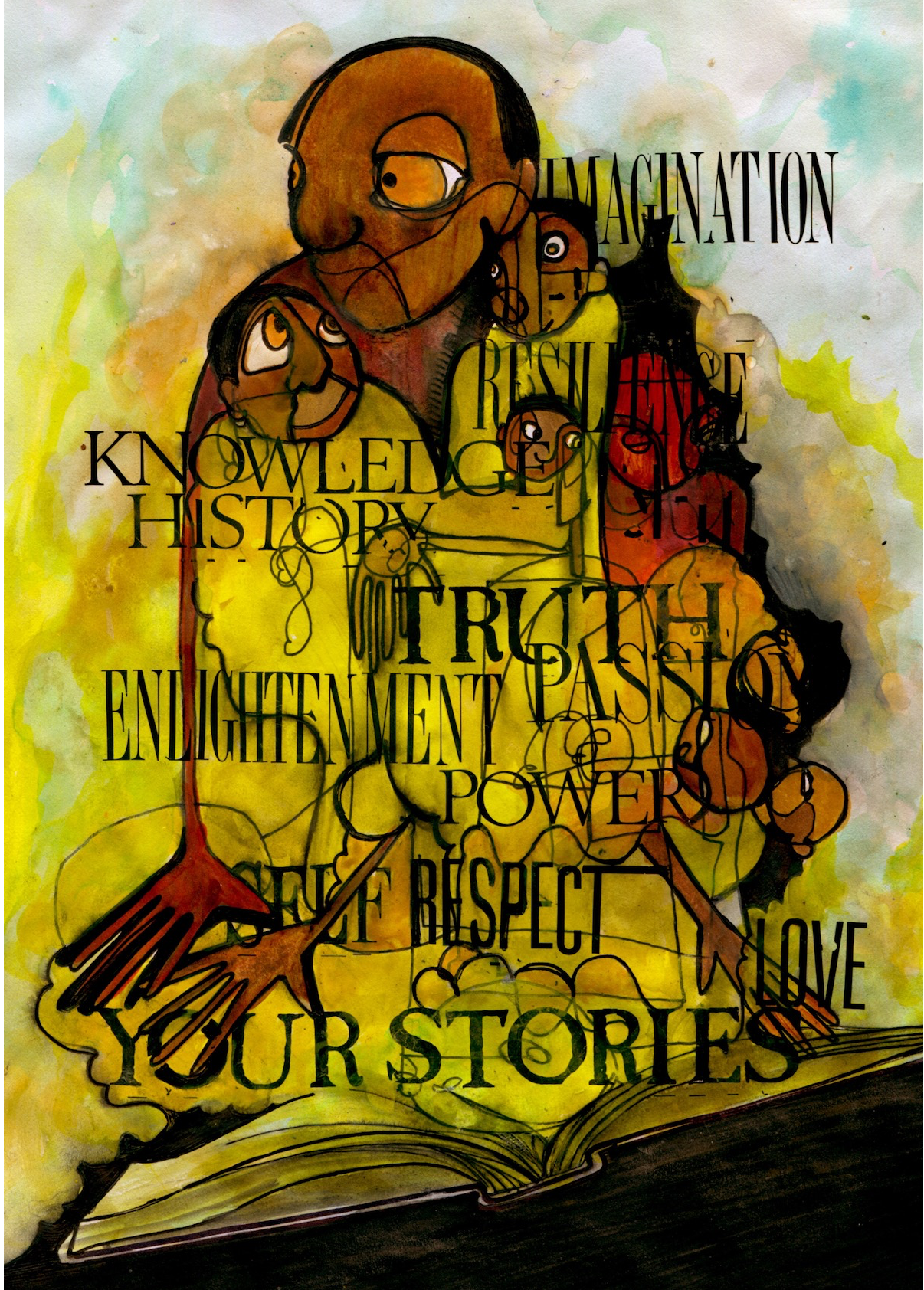
To me, the “race card” is not a card at all. A mere card couldn’t possibly fit all of the reasons I need to challenge and call out racism. My reasons for speaking out span the three continents that form a part of me and hundreds of years of colonialism, immigration, and experience. My race card is not a card: it’s the lives of my ancestors distilled into speckles of my genetic makeup. I’ve accumulated a “race book” full of experience, of bittersweet memories and difficult-to-process feelings, and I stand ready to explain to anyone willing to listen why I will no longer sit down and accept the dismissal embedded in this phrase.
Next time I’m accused of playing the card, I’m throwing down the book.
I collected Barbies and built walls around myself, boxes like the Dreamhouse that took up so much space in my room, plastic walls with sharp corners, fixed surroundings, flowers cut to look like the ones growing by my next-door neighbor’s mailbox but so much less fragile.
So much less fragile.
The architecture of plastic promised that: a permanence and a relief from the softness, the easy-to-hurtness of being a girl and then a woman, I thought. Plastic offered protection (lessons learned later about latex gloves, condoms, barriers designed to stop fluidity—a lovely thought when it comes to blood, to semen). Plastic prevented me from feeling… anything.
This is what I learned when I read Donna Haraway’s A Manifesto for Cyborgs: there is power in abnegating femaleness, in living between body and machine. At the same time, we experience technological waste—that’s something that ecofeminists addressed before Haraway in their paralleling of the female body with the natural world, and that even in a post-human dystopia, structure is ineluctable.
I read Lidia Yuknavitch’s The Book of Joan and Kaethe Schwehn’s The Rending and the Nesta round the same time one of my friends introduced me to plarn. This coincidental juxtaposition, happening as it did during Plastic-Free July and my second viewing of A Plastic Ocean, has made me think about what I have done to my body, what I have done to the earth, and what I make, how it makes and unmakes me, strips of plastic bags pulled tight by plastic needles and sloping loosely from a ball I’ve made over my fingers.
I hate it.
I am making bags out of bags, a metaphor and a reality that is as tangled as the piles of trash I’m pulling together, weaving together to keep myself from falling apart at the seams, to keep my tiny fragment of the world from being filled up with so much waste.
Working with plastic has taught me how frail the substance feels when it has outlived its first use, and I feel sorry for it, sorry for this flimsy substance that falls apart in my hands. I try to make it sturdy, even as I curse it for making me feel dirty (perhaps I should have rinsed off the CAUTION DANGER tape I tore off a cone by a construction site before I began to touch it, finger to needle), culpable for all the things I have thrown away.
The things I have thrown away. The times I have thrown myself away—on men, on meaning, and on meaninglessness. I have been an object, the object, which makes it hard to object. I have been treated as disposable. I have treated myself as disposable, I think, as I imagine the number of wastebaskets by body has filled with tampon applicators, bottled water, Ziploc bags, lip-gloss tubes, mascara wands, plastic hangers from clothes I ended up not wanting.
It is so easy to consume and be consumed in ways that surreptitiously make us feel unworthy, as if we’re made of the stuff that fills so many trash cans and recycling bins. We live in a culture where we want women to look like plastic, to feel like plastic—and to be as easy to dispose of as plastic. Maybe that’s why, as much as I hate it, I’m drawn to the fact that it outlives us, chokes out everything we have stereotypically labeled feminine: water, birth. This so-called disposable product is destined to outlive us.
My disposable body, the body I keep trying to throw away (babies and bathwater seems like the appropriate phrase here) keeps returning. I choke on it like a sea otter or baby seagull stuffed full of trash bags. I choke on it and still float. I am learning that what we view as disposable is in fact not something we should toss without thinking into a receptacle, not something we should put off to the side and pretend never existed. It’s the stuff that matters.
Each ball of plarn, each broken Barbie, and every vinyl record I’d rather melt down than hear out has a story. For example:
The edges of my femaleness have hardened. The landfill of my living room is a series of landmines that I stitch together to create something capable of withstanding the right pressures to tell a different version of sustainability that defies fictions and fibers. I hope.
Plastic is a gift, and I have made the most of Barbies, vinyl albums, and plastic bags by remaking them, lending them a permanence and a new intelligibility.
Plastic is a prison. It ties me to social constructions and reminds me with every stitch how many molecules are fighting for meaning, for space—and how much ends up floating away, causing destruction, rendering itself obsolete and yet unavoidable.
When plastic moves down my arms and I grip it, I am part woman, part object, always.
The domestic depends on it. Grocery bags, Ziploc bags, microwavable containers. It’s no wonder that when people try to go Zero Waste, they have to start in the kitchen and work their way out. How often do we work our way out?
What I make unmakes a small story of destruction. What I use helps, I tell myself, create a tiny bit more space for life in the ocean, for life in our most vulnerable communities, the ones right on the edge of landfills.
On my arms, the plastic feels toxic, not like the living fibers I love to knit.
With it, I am never sure if I am reproducing artifice or unmaking it (e.g., when I told a man that I was making a bag from bags, he perhaps predictably laughed, even though it wasn’t intended to be funny).
We give birth to stories that are objects, too—stories and objects we do not always want to touch and to touch us.
Knitting with plastic has its own kinesthetics. My mother could hear me knitting when I talked to her on the phone. There is, in that, a sensory power and a shifting away from the quietude of crafts toward something more radical.
It’s new and old at once, this repurposing.
About the Maker
Emily Bowles is a writer, advocate, and non-profit management professional whose life was either ruined or saved by watching The Last Unicorn and reading Wuthering Heights too many times. She inherited her love of knitting magical creatures from her grandmother, whose sock monkeys were legendary, and her great aunt, whose quilts told many stories. Emily’s first chapbook, His Journal, My Stella (Finishing Line Press), draws on the research she did as a graduate student on Jonathan Swift and uses it as a framework to tell her own stories of sexual violence and shame. Read more of her poetry online at embowlden.blogspot.com and follow her on Instagram @embowlden77.
As a poet and lover of music, fiction, and other creative media, I’ve always considered art to be magical.
There is something fantastic about how a poem or a song goes from the creator to another person and makes them connect to things. In Daniel José Older’s urban fantasy Shadowshaper, Sierra Santiago uses art to reclaim her magical heritage and strengthen her community.
Set in Brooklyn, New York, Sierra Santiago is an Afro-Latina teenager who just wants to enjoy her summer vacation with her friends. When she notices a neighborhood mural fading and the expression of the subject growing sad and angry, she is urged to finish her own mural by Manny, a friend of her grandfather Lazáro. Then, a walking corpse of a neighborhood man crashes a summer party and Sierra is thrust into the magical world of the shadowshapers. In order to protect her loved ones, Sierra must uncover the shadowshapers’ connection to her family and become a shadowshaper herself.
As an urban fantasy book, the real world manages to feel just as wonderful as the magical world. This is mainly due to the wonderful cast of characters that make up the people in Sierra’s life and the personal backgrounds that they come from. Two of my personal favorite characters were Tee and Izzy, lesbian girlfriends that were funny and loyal. Other favorites included Sierra’s Uncle Neville and Sierra’s intelligent, fashion opposite friend Bennie.
Besides their personalities, each character has a way of speaking that feels magical. One bit of dialogue that caught my attention features a back-and-forth between a group of domino-playing older gentlemen that were friends of Sierra’s grandpa Lazáro. In chapter six, Sierra pays them a visit and hears the following:In the real world, we already use art to remember and pass on the memories, traditions, and cultures of departed loved ones. Murals painted around cities become memorials and certain songs are sung, listened to, and written in tribute. However, Shadowshaper takes these things a step further by using the magic of shadowshaping to fight back against forces that try to eradicate an entire heritage. Protagonist Sierra Santiago must learn not only about shadowshaping, but also to stand up for the neighborhood and the culture that makes her who she is.
At the same time that the shadowshapers are being eradicated, Sierra’s multi-cultural neighborhood is experiencing gentrification. Places that Sierra and her friends used to go to are being transformed into establishments for white, middle class consumers. When the book opens, Sierra is in the middle of painting a mural on a building known as The Tower, a large-scale incomplete building that looms over the junklot where Manny and his friends play dominos. It is later revealed that Manny has a connection to the shadowshapers and that Sierra painting the mural was his way of trying to protect the neighborhood and the remaining shadowshapers.
Not only is Sierra fighting a battle within her own neighborhood, but she is also fighting an internal battle as well. Although she is confident in herself, there are times that she doesn’t feel she is enough of an Afro-Latina girl. Tía Rosa, her aunt, makes comments that contain anti-blackness and colorism (i.e. discrimination based on how light or dark one’s skin tone is). She says that Sierra’s friend Robbie is too dark and that Sierra’s hair is too nappy. In addition, Sierra also deals with sexual harassment while walking around her neighborhood, being shamed by her mom for her interest in shadowshaping, and sexism as a female shadowshaper.
Given all that Sierra experiences in her daily life, her heroic journey is deeply compelling. Sierra uses her artistic talent and shadowshaping to protect her neighborhood and reclaim a magical heritage she learns to appreciate through her family and friends. As a poet, I can’t help but admire Sierra Santiago and see part of myself in her. With paintbrush and chalk, Sierra Santiago shows that an artist can be a hero, a creative making something from shadows in order to express herself and preserve and protect what is important.
The Afro YA promotes black young adult authors and YA books with black characters, especially those that influence Pennington, an aspiring YA author who believes that black YA readers need diverse books, creators, and stories so that they don’t have to search for their experiences like she did.
Latonya Pennington is a poet and freelance pop culture critic. Their freelance work can also be found at PRIDE, Wear Your Voice magazine, and Black Sci-fi. As a poet, they have been published in Fiyah Lit magazine, Scribes of Nyota, and Argot magazine among others.
“Trouble at school, Sierra?” asked Mr. Jean-Louise. “Public school is a cesspool of poisonous bile.”
Manny threw his hands up, “¡Cállate, viejo!The child needs her education. Don’t ruin it for her just because you dropped out of kindergarten.”
Since the characters have strong ties to each other and their neighborhood, having the magical world of shadowshaping just underneath it makes them even more memorable. Shadowshaping involves giving spirits of departed loved ones and ancestors a physical form by fusing them with art. For Sierra and the other shadowshapers she encounters, the art is mainly visual, but shadowshaping can also be done through other creative means such as storytelling. The purpose of shadowshaping is to remember those who have come before and recently passed, preserving the past and present for the future generations.
In the real world, we already use art to remember and pass on the memories, traditions, and cultures of departed loved ones. Murals painted around cities become memorials and certain songs are sung, listened to, and written in tribute. However, Shadowshaper takes these things a step further by using the magic of shadowshaping to fight back against forces that try to eradicate an entire heritage. Protagonist Sierra Santiago must learn not only about shadowshaping, but also to stand up for the neighborhood and the culture that makes her who she is.
At the same time that the shadowshapers are being eradicated, Sierra’s multi-cultural neighborhood is experiencing gentrification. Places that Sierra and her friends used to go to are being transformed into establishments for white, middle class consumers. When the book opens, Sierra is in the middle of painting a mural on a building known as The Tower, a large-scale incomplete building that looms over the junklot where Manny and his friends play dominos. It is later revealed that Manny has a connection to the shadowshapers and that Sierra painting the mural was his way of trying to protect the neighborhood and the remaining shadowshapers.
Not only is Sierra fighting a battle within her own neighborhood, but she is also fighting an internal battle as well. Although she is confident in herself, there are times that she doesn’t feel she is enough of an Afro-Latina girl. Tía Rosa, her aunt, makes comments that contain anti-blackness and colorism (i.e. discrimination based on how light or dark one’s skin tone is). She says that Sierra’s friend Robbie is too dark and that Sierra’s hair is too nappy. In addition, Sierra also deals with sexual harassment while walking around her neighborhood, being shamed by her mom for her interest in shadowshaping, and sexism as a female shadowshaper.
Given all that Sierra experiences in her daily life, her heroic journey is deeply compelling. Sierra uses her artistic talent and shadowshaping to protect her neighborhood and reclaim a magical heritage she learns to appreciate through her family and friends. As a poet, I can’t help but admire Sierra Santiago and see part of myself in her. With paintbrush and chalk, Sierra Santiago shows that an artist can be a hero, a creative making something from shadows in order to express herself and preserve and protect what is important.
The Afro YA promotes black young adult authors and YA books with black characters, especially those that influence Pennington, an aspiring YA author who believes that black YA readers need diverse books, creators, and stories so that they don’t have to search for their experiences like she did.
Latonya Pennington is a poet and freelance pop culture critic. Their freelance work can also be found at PRIDE, Wear Your Voice magazine, and Black Sci-fi. As a poet, they have been published in Fiyah Lit magazine, Scribes of Nyota, and Argot magazine among others.
The best I continue to have, to enjoy, and to love is Toni Morrison. But I don’t read her: she reads to me.
The power in her narrative, the pain she digs out of your insides, the metaphorical genius that cuts through the literal mind and forces you to search for her meaning, the unmatched concision of her speech—with not one misplaced thought or misdirected angle, not a single sentence overrun or a phrase understated.
She is the reason I write. She is the reason I embrace my own pain and attempt to transcribe it into words.
My relationship with Morrison began in my freshman year of high school, over a decade ago, when I was required to read The Bluest Eye. I had never read anything so figuratively convincing before. I had never read something that addressed the most intensely personal situations and deep-rooted conflict from the eyes and mind of an eleven-year-old girl.
Upon reaching the conclusion of Bluest Eye, I remember having a tiff with a classmate about whether the color of Pecola’s eyes changed. My argument was that the color of Pecola’s eyes changed because she believed it, and no further explanation was required. A “what is real to me versus what is actually real” debate commenced ,and it was fantastic. Morrison’s style is so poetic, symbolic, and majestic that she eliminates the distinction between the two, and as a result, what is real to me is actually real.
Morrison transformed my way of looking at the world. She changed the lens with which I viewed my surroundings, and this transformation felt incredibly emancipating.
Morrison transformed my way of looking at the world. She changed the lens with which I viewed my surroundings, and this transformation felt incredibly emancipating.
I began to delve past the façade of pasted-on facial expressions and rehearsed laughter for that deeper meaning behind closed eyes and mute tongues. I am that person who wants to hear your story from beginning to end: I gasp, ooh and aah, I tear up, I become angry when you become angry, I smile when you pour your heart out, I feel the love you declare.
I always enjoyed listening to people’s stories, especially those of the elderly and the traveled. Morrison taught me to find the pain and struggle in the untold parts of their stories, to piece together the meaning of their incredible journeys, and, finally, to tie it all back to the unbelievable strength of the individual.
When learning about the sequence of events that led up to major conflict across borders, involving key political figures and nations, I wanted to travel back in time to ask the people of that time and place how they felt. I wasn’t solely interested in the decision-making process: I wanted to have a lengthy conversation with a layperson and his or her family.
I am a bit of a history buff. Even now, my DVR is overrun with History Channel pieces. This interest in history led to my discovery of sociohistorical fiction. When learning about the sequence of events that led up to major conflict across borders, involving key political figures and nations, I wanted to travel back in time to ask the people of that time and place how they felt. I wasn’t solely interested in the decision-making process: I wanted to have a lengthy conversation with a layperson and his or her family. Sociohistorical fiction allows an inside view of the social impact history had on families, kids, lovers, and leaders. Although some literature and personal reflections have been preserved, we don’t have social media, blogs, and limitless creative expression from people of other time periods. Without these sources, it is nearly impossible to fathom the feelings and sensations of a people through uprising, turmoil, political upheaval, famine, disease, and loss. These unknowns spark such an interest in me. I want to do the research and be the historian. I want to be able to feel, somehow, or get even the slightest glimpse into those minds.
She presents perfected characters with their socially labeled “imperfections,” an underlying civil issue sets the tone, and she brings in perspectives from the old and young, the brave and the forgotten, the now and the then.
Although I read some historical fiction prior to Morrison, her style was unlike any HF I had encountered to that point. What is magnificent about her way of writing is her ability to tell a story within a story. This is where metaphor meets sociohistory. The exploitation and dehumanization of blacks throughout history, and still to this day, is the backdrop of her novels. She presents perfected characters with their socially labeled “imperfections,” an underlying civil issue sets the tone, and she brings in perspectives from the old and young, the brave and the forgotten, the now and the then. It is literary brilliance the way she agilely impels the reader to come face to face with the grueling catastrophes of black history, from slavery to torture to rape to liberation, seclusion, domination, and debasement.
I’ve cried many times during a good read, but this was the first time I actually had to close the book about halfway through and put it away. I was solemn for days and could not get myself to pick it up again and finish. Never before had words stabbed at my soul so deep.
For me, the literary agony in Beloved was unbearable. I’ve cried many times during a good read, but this was the first time I actually had to close the book about halfway through and put it away. I was solemn for days and could not get myself to pick it up again and finish. Never before had words stabbed at my soul so deep. I tried finishing it later that year, yes, I tried many times that year. Peeking at the next page, skimming it over to see if the bad was gone and some good was on its way. I read a few lines but felt the wounds reopening. I had to close it yet again and reshelve it until I was at a different, more mature stage in my life, about eight years later—at a point when I had seen and experienced a little too much, but enough to solidify my spine.
My familiar tears resumed, my heart stiffened and clenched through to the very last word. It almost felt like I was holding my breath through the remainder of the book. Upon concluding this masterpiece, when I could breathe again, I was ready to write.
It’s extremely difficult to put into words exactly what Morrison did for me. She awoke a silent, creative part of me. She encouraged me to unscramble a not-quite-perfect sentence to make it right. She pushed me, in a complex, tenderly firm manner—she pushed me outside my comfortable boundaries and stood me up to face, internalize, and express. She navigated me to the darkest corners of my inner self and helped me find peace with everything hiding there.
Most importantly, she has taught me to embrace all that is good and all that is me.
I set out to write my story about a cursed cowgirl and a magic gun.
In 2010, I was zealously playing an action-adventure Wild West video game called Red Dead Redemption by Rockstar Games.
The game follows ex-outlaw John Marston, on a quest to atone for his past and save his family from a shady government agency during the early twentieth century. It is deep, moving, engrossing, and a helluva lotta fun…everything I wanted my own stories to be.
I’d just published my debut contemporary romance under my other pen name, Vicki Essex, when the thought came to me: Why weren’t there more fantasies set in the Wild West? Why were so many magical worlds set in feudal fairytale kingdoms with castles and kings and wizards?
And so The Devil’s Revolver was born. I’d always been a reader of YA fantasy and aspired to publish in the genre. Fueled by hours of playing through bloody gunfights and long horseback rides across a seemingly endless, beautifully rendered landscape, I set out to write my story about a cursed cowgirl and a magic gun.
I knew from the start that Hettie Alabama would have a long journey ahead of her. She was also coming of age in a world where women’s roles were still limited, where brutal violence was commonplace, and where justice didn’t always mean fairness or satisfaction.And then I handed her a legendary long-lost cursed weapon everyone was after.
The question was, would anyone want to read a Western, even if there was magic in it? Despite the number of successful cross-genre stories like the Joss Whedon show Firefly (another inspiration) and Cowboys vs. Aliens (who doesn’t love Daniel Craig?), I realized that getting an audience hinged on two things: characters and world building.
I knew from the start that Hettie Alabama would have a long journey ahead of her. She was hardworking, family-centered, hard-headed—a product of her sometimes harsh surroundings with both boots planted firmly on the ground. She was “mundane,” bearing no magic gift of her own, and her only concerns for the future were ensuring the safety and security of her parents and little sister, Abby. She was also coming of age in a world where women’s roles were still limited, where brutal violence was commonplace, and where justice didn’t always mean fairness or satisfaction.
And then I handed her a legendary long-lost cursed weapon everyone was after.
When I started, I knew that magic had a price, that it was as precious as gold, nearly as scarce, and dwindling in intensity and supply. Sorcerers didn’t waste magic on frivolities—spells had to be as pragmatic as Hettie herself was.
Building the magical world around Hettie was more challenging than I’d anticipated. The world of The Devil’s Revolver started as one that was basically turn-of-the-century American, “but with magic.” History happened as it had, “but with magic.” Science and technology kept pace with real-life timelines for the most part, “but with magic.” It wasn’t a tough stretch—when you can imagine a spell to make something happen, you can imagine a counterspell to stop it from happening.
I kept the use of magic sparse and practical. When I started, I knew that magic had a price, that it was as precious as gold, nearly as scarce, and dwindling in intensity and supply. Sorcerers didn’t waste magic on frivolities—spells had to be as pragmatic as Hettie herself was, but also life-altering in the same way indoor plumbing might be in a rural household.
I couldn’t just appropriate rituals, beliefs, and ceremonies to fit into my story. To some groups of people, these magical traditions were real.So began my own journey to decolonize my writing.
What I hadn’t really considered until well into the first draft was just how complex the system of magic would be in this world, and what it would mean to various characters and cultural groups. I couldn’t just appropriate rituals, beliefs, and ceremonies to fit into my story. To some groups of people, these magical traditions were real.
So began my own journey to decolonize my writing. As a result, “magic” in Hettie’s world, as I conceived it, couldn’t be a single overriding tradition, nor could it necessarily all come from one single source as more rigorous standards for world building might require. Every culture has its own forms of magic, whether it’s fortune-telling, prayer, conversing with otherworldly beings, healing, manipulating others…the list goes on and on. In short, “magic” allows us to trust in what is and what can be achieved through various customs or rituals without qualifying its value. Some people call this faith.
The journey’s a long one, for myself and for Hettie. I hope you’ll enjoy The Devil’s Revolver and come back for the rest of the series, coming soon from Brain Mill Press.
The Many Different Loves of "Let's Talk about Love"
When people think of love, romantic love comes to mind. It is often tied with sexual attraction and the act of sex, seemingly inseparable.
As a result, asexual people who experience romantic attraction but not sexual attraction have a hard time explaining their identity to potential romantic partners as well as friends and family. In Claire Kann’s debut young adult novel Let’s Talk About Love the main lead is a Black biromantic asexual girl named Alice who is learning to redefine and appreciate the several types of love she experiences.
When it comes to asexuality, it is important to note that it exists on a spectrum that consists of a lack of sexual attraction as well as a lack of romantic attraction. Let’s Talk About Love features only one facet and experience of asexuality and should not be treated as a definitive text. However, there is no denying that it’s a notable book in more ways than one. Unlike most teen coming-of-age stories, this one is set in college during summer. This allows for a realistic, easygoing plot that focuses on self-discovery.
Unlike most teen coming-of-age stories, this one is set in college during summer. This allows for a realistic, easygoing plot that focuses on self-discovery.
When the novel opens, Alice has just been dumped by her girlfriend Margot because she doesn’t understand Alice’s asexuality. Alice is especially hurt because Margot thinks that Alice doesn’t want to have sex with her because she doesn’t love her. Since Alice is already uncomfortable with being open with her asexuality, this breakup makes things worse. As a result, she has a hard time recognizing her feelings for her new library co-worker Takumi and dreads coming out to him.
With the help of a therapist, Alice starts to get in touch with her feelings, becomes closer to Takumi and her friends Fennie and Ryan, and starts moving out from under her parents’ career expectations. As she does this, she comes to realize the various types of love she is capable of experiencing and enjoying without giving in to heteronormative expectations. A fun aspect of this is Alice’s love for pop culture.
Although it’s not a major part of the book, Alice’s passion for pop culture is such a quirky and charming part of her character that you can’t help but smile. Thinking of love and passion in terms of how much you enjoy a thing is valuable; to see Alice do this so naturally is wonderful. She jokes about getting a degree in watching Netflix and Hulu. She cosplays as Velma Dinkley from Scooby Doo. It’s amusing and nice because it becomes something she shares with her friends and Takumi out of love for them.
She comes to realize the various types of love she is capable of experiencing and enjoying without giving in to heteronormative expectations.
In fact, Alice’s love for her friends Feenie and Ryan are just as powerful as her feelings for her love interest Takumi. In the book, she finds herself becoming a third wheel to Feenie and Ryan, slowly drifting apart from them as she spends more time with Takumi. After an incident where she feels her friends abandoned her, she and her friends become estranged until they have a talk about how they need to balance their relationships with each other.
It’s important to note Alice’s friendships.
Some young adult books focus on romance more than friendship, especially when romance is a major part of the plot. When a girl gets a love interest in a book like The Fault in Our Stars or Pushing the Limits, it feels like the girl’s entire world revolves around them. Another notable factor in this book is the rarity of having a Black female teen dealing with things like romance and friendship instead of extreme hardship. Although Alice does deal with microgressions, her personality is that of a carefree Black girl trying to happily live her life.
Meanwhile, Alice’s relationship with Takumi is notable because it evolves from friendship to romance. In fact, ninety-five percent of the book involves friendship. While this caused the romance scenes to be rushed at the end, having their friendship grow to romance works in Alice’s favor. Alice is allowed to figure out what exactly attracts her to Takumi, what type of attraction she feels for him, and how much she likes him versus how much she is attracted to him. Takumi is allowed to do the same and his relationship with Alice is all the better for it.
Let’s Talk About Love is a wonderful exploration of love in various forms. Alice’s coming-of-age story is entertaining and thoughtful because it shows that friendship, romance without sex, and personal passions are filled with just as much love as anything sexual.
All in all, Let’s Talk About Love is a wonderful exploration of love in various forms. Alice’s coming-of-age story is entertaining and thoughtful because it shows that friendship, romance without sex, and personal passions are filled with just as much love as anything sexual. It forces the reader to consider what makes love special to them and why certain types of love are given a higher value than others. Let’s Talk About Love both entertains and starts a conversation; more people should be reading and talking about this book.
The Afro YA promotes black young adult authors and YA books with black characters, especially those that influence Pennington, an aspiring YA author who believes that black YA readers need diverse books, creators, and stories so that they don’t have to search for their experiences like she did.
Latonya Pennington is a poet and freelance pop culture critic. Their freelance work can also be found at PRIDE, Wear Your Voice magazine, and Black Sci-fi. As a poet, they have been published in Fiyah Lit magazine, Scribes of Nyota, and Argot magazine among others.

 I collected Barbies and built walls around myself, boxes like the Dreamhouse that took up so much space in my room, plastic walls with sharp corners, fixed surroundings, flowers cut to look like the ones growing by my next-door neighbor’s mailbox but so much less fragile.
 I read Lidia Yuknavitch’s The Book of Joan and Kaethe Schwehn’s The Rending and the Nesta round the same time one of my friends introduced me to plarn. This coincidental juxtaposition, happening as it did during Plastic-Free July and my second viewing of A Plastic Ocean, has made me think about what I have done to my body, what I have done to the earth, and what I make, how it makes and unmakes me, strips of plastic bags pulled tight by plastic needles and sloping loosely from a ball I’ve made over my fingers.
 The things I have thrown away. The times I have thrown myself away—on men, on meaning, and on meaninglessness. I have been an object, the object, which makes it hard to object. I have been treated as disposable. I have treated myself as disposable, I think, as I imagine the number of wastebaskets by body has filled with tampon applicators, bottled water, Ziploc bags, lip-gloss tubes, mascara wands, plastic hangers from clothes I ended up not wanting.
 My disposable body, the body I keep trying to throw away (babies and bathwater seems like the appropriate phrase here) keeps returning. I choke on it like a sea otter or baby seagull stuffed full of trash bags. I choke on it and still float. I am learning that what we view as disposable is in fact not something we should toss without thinking into a receptacle, not something we should put off to the side and pretend never existed. It’s the stuff that matters.

Recent Comments