“Nine Months,” “Cryptic Crossword LV,” “Her / Him / Our / Their / Us / Them / They Body,” and “Jaws Was on TV on a Saturday Morning”

“Nine Months,” “Cryptic Crossword LV,” “Her / Him / Our / Their / Us / Them / They Body,” and “Jaws Was on TV on a Saturday Morning”

Editors' Choice Picks

We are delighted to present this week’s selections from the Brain Mill Press Poetry Month Contest, Break Poetry Open, by talented poets Raymond Luczak, Holly Painter, henry 7. reneau, jr., and Mercury Marvin Sunderland.

We hope you’ll enjoy these editors’ picks as much as we did.

Nine Months

Raymond Luczak

mom still wonders how i lost my hearing
she mentions having a miscarriage in april 65

& being surprised to find herself pregnant

again in june 65 dr santini said id be born in january 66
instead i arrived in november 65 fully formed

not a preemie i go home two days later

not long after my sister carole takes
to reading out loud from a book
she is learning how to read to me
as i am trapped in my crib
i have apparently cocked my ears

to her voice laboriously decoding words

then mom changes her story

she remembers having the miscarriage in march 65
it fell out of her while she sat on the toilet

at 16 i constantly wondered

if that was indeed possible

a body expelling her own fetus

a heatwave in july 66

i turn pink & hot but everybody is hot anyway

mom wonders maybe somethings seriously wrong

at the hospital i am found to have double pneumonia

& a high fever i look close to dying so a priest is called in
i survive my last rites of death but my hearing doesnt

then mom changes details again

she says she had a d&c done in february 65
when she felt her fetus wasnt growing

it wasnt even two centimeters long
no idea whether it was a boy or girl
i no longer am sure what to believe

after i come back from the hospital

carole reads to me again

this time i bob my head around

she doesnt realize ive lost most of my hearing
no one has either
she gets frustrated with me & gives up

by the time i turn 2 & a half

mom asks her doctor why i havent begun talking

he says maybe hes deaf

she comes home & tells dad to stand me up & turn me

so i can face the wall up in the tub since he was washing me
i don’t respond to my name

research indicates a twin in the womb could miscarry
leaving behind its other half

in the 60s technology hadnt existed to detect

such a tiny baby
thats why moms pregnant test results in june 65
had so surprised everyone

up & down oak street where i once roamed
the trees are mostly gone

but the shadow of my other half

still runs a mean yellow stripe
right through the road of my life
the mystery of never knowing him

Jareen Imam author photo

Raymond Luczak is the author and editor of 22 books, including Flannelwood (Red Hen Press) and Lovejets: Queer Male Poets on 200 Years of Walt Whitman (Squares & Rebels). He lives in Minneapolis, Minnesota. His online presence includes: raymondluczak.com, facebook.com/raymondsbooks, and twitter.com/deafwoof.

Cryptic Crossword LV

Holly Painter

Jareen Imam author photo

Holly Painter lives with her wife and son in Vermont, where she teaches writing and literature at the University of Vermont. Her first full-length book of poetry, Excerpts from a Natural History, was published by Titus Books in Auckland, New Zealand, in 2015. Her poetry, fiction, and essays have also been published in literary journals and anthologies in the US, Canada, Australia, New Zealand, China, Singapore, and the UK.

Her/Him/Our/Their/Us/Them/They Body

henry 7. reneau, jr.

Jareen Imam author photo

henry 7. reneau, jr. writes words of conflagration to awaken the world ablaze, an inferno of free verse illuminated by his affinity for disobedience, like a chambered bullet that commits a felony every day, an immolation that blazes from his heart, phoenix-fluxed red & gold, exploding through change is gonna come to implement the fire next time. He is the author of the poetry collection, freedomland blues (Transcendent Zero Press) and the e-chapbook, physiography of the fittest (Kind of a Hurricane Press), now available from their respective publishers. Additionally, he has self-published a chapbook entitled 13hirteen Levels of Resistance, and his collection, The Book Of Blue(s) : Tryin’ To Make A Dollar Outta’ Fifteen Cents, was a finalist for the 2018 Digging Press Chapbook Series. His work has also been nominated for the Pushcart Prize.

Jaws Was on TV on a Saturday Morning

Mercury Marvin Sunderland


Mercury Marvin Sunderland is a gay Greek/Roman Wiccan autistic transgender man who uses he/him pronouns. He’s from Seattle. He currently attends The Evergreen State College, and his dream is to become the most banned author in human history.

Mercury is a 2013, 2014, 2015 winner of ACT Theater’s Young Playwright’s Program, a 2015, 2016 selected playwright for ACT Theater’s 14:48 HS, a 2016 winner of the Jack Straw Young Writer’s Program, a 2016 selected participant for the Seattle Talent Show hosted by Rainier Beach High School, and was hired as a paid representative of Youth Speaks Seattle in 2016. In 2017 alone, he was selected for and won the 2017 Youth Speaks Seattle Grand Slam, and went off as one of the top five youth slam poets representing Seattle at Brave New Voices 2017, an international slam poetry tournament treated as America’s national tournament, and was selected to perform slam poetry alongside former Seattle mayor candidate Nikkita Oliver at the University of Washington. In 2018 his illustrations were selected for While Supplies Last, an art show hosted by Anthony White, a Cornish College of the Arts graduate. In 2019 he received his first literary journal acceptance from Fearsome Critters Literary Magazine Volume Two, his second from the February 2019 issue of Marathon Literary Review, his third and fourth from Across & Through Literary Magazine, and his fifth from The Dollhouse Literary Magazine.

National Poetry Month

BMP Celebrates National Poetry Month

For this year’s National Poetry Month, Brain Mill Press & Voices want to add to your #TBR pile, sing siren songs of unsung heroes, and signal boost living poets we should be reading more. By the end of the month, we hope you will have acquired 30+ new books of poetry and that they continue to multiply in the darkness of your library. Explore new voices & new forms — re-read some old favorites — play if you liked this poet, you’ll like… the old-fashioned way, algorithm-free — just poetry lovers talking to poetry lovers, as the Universe intended. Happy #NaPoMo2019 from Brain Mill Press.


Break Poetry Open Contest Winner

Break Poetry Open Contest Winner

Hannah Soyer

—C. Kubasta, Editor, BMP Celebrates National Poetry Month 2019

Winner

“what do i know about consent anyway” by Hannah Soyer

Short List

“A composing book, 1973” by Daisy Bassen

“FOR COLORED GURLS WHO HAVE CONSIDERED SUICIDE WHEN THE TWIST OUT WAS NOT ENUFF” by Levi Cain

“[mispronunciation]” by Uma Menon

Editors’ Picks

Week Five

“To: that nought in da jcemestry” by Penelope Alegria

“To Cry Out” by Cassandra Hsiao

“This Cosmic Dance” by Natasha McLachlan

what do i know about consent anyway

Contest Winner

Hannah Soyer

About Hannah Soyer

Hannah Soyer is a disabled creative writer and artist interested in perceptions and representations of what we consider ‘other.’ She is the creator of the This Body is Worthy project, which aims to celebrate bodies outside of mainstream societal ideals, and the founder of Freedom Words, a program to design and implement creative writing workshops specifically for students with disabilities. She has been published in Cosmopolitan, InkLit magazine, Mikrokosmos Journal, Hot Metal Bridge, Rooted in Rights, and her most recent piece, ‘Displacement,’ has been nominated for a Pushcart Prize.

thisbodyisworthy.com

Twitter/Instagram: @soyernotsawyer

A composing book, 1973

Short-List Selection

Daisy Bassen

The book is old.
The book has a yellow cover.
The book was given to me by my father.
My father was a teacher.

The book is simple.
The book is deceptive.
Deceit is valuable.
Deceit is proscribed.

The sentences are short.
The sentences make a song.
The sentences want involution.
A clause has claws.

The claws are yellow.
The claws are old.
The sentences are about bombs.
The sentences are about immolation.

The book belonged to a girl.
The girl was a student.
She learned about bombs.
The yellow of immolation.

The sentences are about runaways.
She ran away.
The girl.
Clawed.

About Daisy Bassen

Daisy Bassen is a practicing physician and poet. She graduated from Princeton University’s Creative Writing Program and completed her medical training at The University of Rochester and Brown. Her work has been published in Oberon, The Delmarva Review, The Sow’s Ear, and Tuck Magazine as well as multiple other journals. She was a semi-finalist in the 2016 Vassar Miller Prize in Poetry, a finalist in the 2018 Adelaide Literary Prize, a recent winner of the So to Speak 2019 Poetry Contest and was doubly nominated for a 2019 Pushcart Prize. She lives in Rhode Island with her family.

National Poetry Month

FOR COLORED GIRLS WHO HAVE CONSIDERED SUICIDE WHEN THE TWIST OUT WAS NOT ENUFF

Short-List Selection

Levi Cain

swear on my mama
no–swear on something more
simple and sacred.
swear on my brother’s future mixtape,
swear on pig fat in collard greens and
freshly whipped shea butter,
arroz con what the fuck ever–
that the cracked cushion chair of
my hairdresser’s closet is
in fact a cathedral,
packets of yaki and remy dotted
with the same angels,
skin the color of good brandy.
the nollywood movies blaring
on the thrifted television is
the preacher.
there is one constant truth–
the half-room in waltham is
a tabernacle for second generation girls
who never learned how to cornrow.

a blackgurl’s bond with a hairdresser
is tighter than the binding of isaac,
requires more faith than you
ever know how to give
after years of lye being applied
to your scalp,
after years of being teased by
whitegirls who crow that
your hair looks like brillo pads
that they wouldn’t let their housekeepers
scour the sink with.
the same whitegirls who now quiz you
on coconut oil
and ask you to anoint them
with the wisdom of
deep conditioning.

i and every other blackgurl
who grew up in the suburbs
are haunted by visions of hot combs
and strangers putting their hands in our hair,
pulling so sharply we swear
we hear the echo of a whip crack.

but those ghosts have no place here,
in this space that has only space enough
for you,
your hairdresser,
and maybe her friend from haiti
who you do not know the name of
but who twists braids so gently it is
as if she wants to be your mother.

this is an act of love,
but all gods are not filled with goodness
and so neither is the woman
who stands with jojoba in her right hand,
84 inches of kankelon in her left,
who asks why you never
seem to have a boyfriend,
who told you she would rather die
than break bread with faggots
but passes you plantains as communion,
presses your forehead
to her chest as madonna,
calls you daughter,
welcomes you with open arms
to a rented room
in a part of a town that would make
a principal’s lip curl
–this blackgurl bethlehem,
this satin covered resting place,
this plane of being where
you are you
are blackgurl,
are celebration,
are miracle,
are nothing but holiest of holies.

About Levi Cain

Levi Cain is a queer writer from the Greater Boston Area who was born in California and raised in Connecticut. Further examples of their work can be found in Lunch Ticket, Red Queen Literary Magazine, and other publications.

[mispronunciations]

Short-List Selection

Uma Menon

i try to pull out a chameleon’s
tongue from inside my throat,
change the color, change it all
before another
……………[mispronunciation]
leaves my colorless mouth

instead i find my mother tongue
stuck inside my throat, a lump
forgotten only by me
& i find a desire, tucked away,
to strangle her and choke myself
before another
……………[mispronunciation]
escapes without explanation

i am afraid that i have stained
the english that i speak
that it yearns to be bleached
in cold sand

i watch my mother chug down
womanhood,
let it slide through the grip of her
mother tongue,
into the stomach of America
……………[& her mispronunciations]

About Uma Menon

Uma Menon is a fifteen-year-old student and writer from Winter Park, Florida. Her writing has appeared or is forthcoming in the Huffington Post, The Rumpus, and National Poetry Quarterly, Sahitya Akademi’s Indian Literature, and the Cincinnati Review, among others. Her first chapbook was published in 2019 (Zoetic Press); she also received the 2019 Lee Bennett Hopkins Award in Poetry.

National Poetry Month

To: that noght in da jcemetsry

Contest Editors’ Pick

Penelope Alegria

Th city light s r beutiful 2night.
Sky twinkles starligt on sidwalks
with cracks that almost shape like ur
sillhouette in twinkling moondust.
Clay polish tatters blu on ashes of
cigar wrappers flickering burnt blac
n im thinkn of the time u rolled roun
in somebody else’s ashes in that gravyard
next to the church with the clouds
rdy to snow upside down crosses.

Did u kn o th grass smells lik tequila
n th boys breaths smells like lilac
flickering burn t blqck sparks n my
legs feel like pillow n l8ly it dpens’t feel
right wrapping myself up in white
bedsheets bc they dont feel wuite as
electric as ur fingertips n m drunk

Im drunk im dunk m drnk n i want
u nex to me w legs like pillows n
breath like lilac burnt black n u
rollin around in someboyd else’s ashes
n i dk y u wouldnt want that eithr

About Penelope Alegria

Penelope Alegria has participated in Young Chicago Authors’ artistic apprenticeship, Louder Than a Bomb Squad. Her work has been featured or is forthcoming in La Nueva Semana Newspaper and El Beisman. Penelope was among the top 12 poets in Chicago as a Louder Than a Bomb 2018 Indy Finalist and was awarded the Literary Award by Julian Randall. She has performed spoken word at The Metro, University of Chicago, and elsewhere.

National Poetry Month

To Cry Out

Contest Editors’ Pick

Cassandra Hsiao

yellow: the cold echo of collapse muddled muddied
house of decay return to the ground that bore me
grow betrayal roots below mold my fingertips
bleed flag i no longer show pale yellow: crayoned
sun shine shield i risk changing colors if i don’t
yellow: aroma that does not lie trapped in tin pots roasted
crisp red brown duck i can taste home cannot find home
sell home know home remember touch of yellow: lazy tongue
remarks sting firecracker never cool enough to swallow yellow:
taste morning hours sunrise son rise sweet victory to open shop
open bells jingle lucky cat licks its paws yellow: eyes
glass over cat looks white yellow: light

About Cassandra Hsiao

Cassandra Hsiao is a rising junior at Yale University, majoring in Theater Studies and Ethnicity, Race & Migration. Her poetry, fiction, and memoirs have been recognized by Rambutan Literary, Animal, Claremont Review, Jet Fuel Review, and National YoungArts Foundation. Her plays have been selected as finalists for national playwriting competitions held by The Blank Theatre, Writopia Labs, Princeton University, Durango Arts Center, California Playwrights Project, and YouthPLAYS. Her work is currently being produced in theaters across the nation. She has also won a Gracie Award for her entertainment journalism and was recognized as a Voices fellow for the Asian American Journalists Association (AAJA).

Instagram/Twitter: @cassandrahsiao

Facebook: https://www.facebook.com/LoveCassandraHsiao/

National Poetry Month

This Cosmic Dance

Contest Editors’ Pick

Natasha McLachlan

About Natasha McLachlan

Natasha McLachlan is a poet currently living in Southern California. After losing her speech in 2018 due to unforeseen circumstances, she fell in love with reading all over again, as it helped her cultivate self-care–this, she hopes, will be a cure for others in a hectic and frantic lifestyle. She was a first-generation college student, graduating from California College of the Arts with a bachelor’s degree in Writing and Literature. As a minority, she takes pride in breaking the barriers and stigma around individuals of color by simply being herself. When she is not writing, she is spending time with her family or bonding with her 9 siblings, whom she considers her best friends. Her inspiration comes from the moons and stars around her, nature being her greatest muse.​

National Poetry Month

BMP Celebrates National Poetry Month — Break Poetry Open

For this year’s National Poetry Month, Brain Mill Press & Voices want to add to your #TBR pile, sing siren songs of unsung heroes, and signal boost living poets we should be reading more. By the end of the month, we hope you will have acquired 30+ new books of poetry and that they continue to multiply in the darkness of your library. Explore new voices & new forms — re-read some old favorites — play if you liked this poet, you’ll like... the old-fashioned way, algorithm-free — just poetry lovers talking to poetry lovers, as the Universe intended. Happy #NaPoMo2019 from Brain Mill Press.

Interview Erasure

Interview Erasure

Rita Feinstein

Interview Erasure

a poem for anyone who is bad at giving direct answers to questions

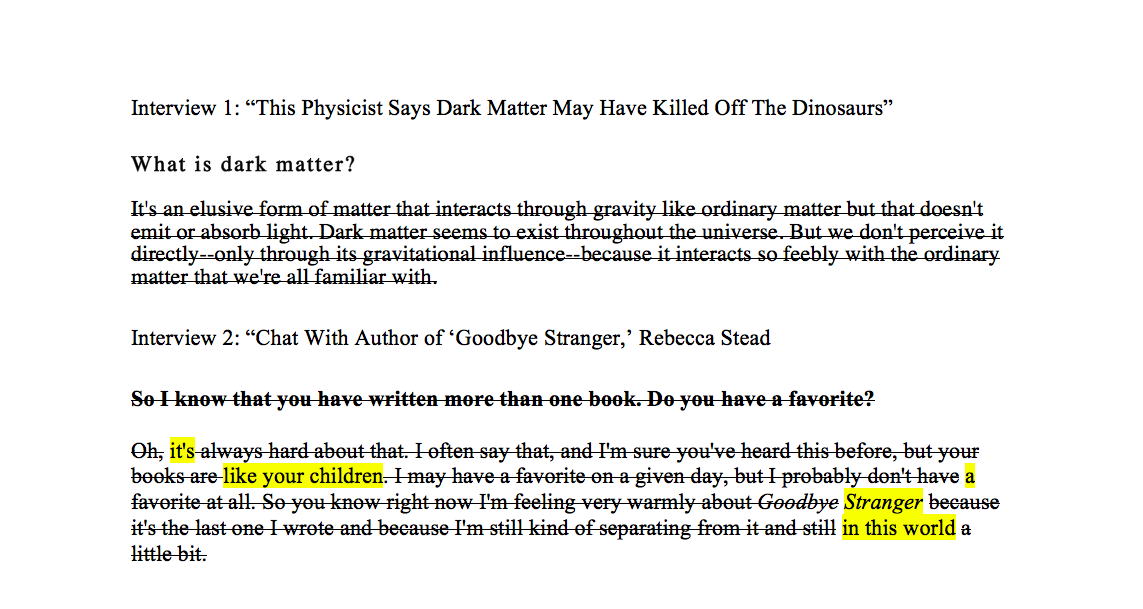
(1)   Find two interviews on different topics. Let’s call them Interview One and Interview Two.

(2)   Copy down only the questions from Interview One.

(3)   Using only the responses from Interview Two, answer these questions. Instead of simply copying-and-pasting, approach each response as an erasure, extracting the words necessary to “answer” the questions. You may take as much or as little of the original text as you wish.

(4)   You should go through the Q&A in order, using the first response from Interview Two to answer the first question in Interview One. And so on and so forth.

(5)   The interview ends when you run out of questions or responses, e.g. if Interview One contains more questions than Interview Two does answers.

SAMPLE

What is dark matter?

It’s like your children. A stranger in this world.

Is dark matter made of atoms?

Well, it’s easier to fabricate something that small, true.

If it’s invisible, why call it “dark?”

I don’t. But other people do.

How can we tell dark matter exists?

People make us feel badly. Sometimes love is very boring.

Dark matter was first hypothesized many decades ago. Tell us about that.

I would like to see you more. I’d like to see a slightly less pretty you.

What is the current state of knowledge about dark matter?

There’s still time to fix things.

Do new findings about dark matter tell us anything about the origins of the universe?

There is this idea that matter—it’s complicated.

How about the existence of multiple universes—the so-called multiverse?

It was a challenging space but a safe space. Now, it’s very very different. Your problems follow you home.

Speaking of your book, what is the connection between dark matter and the dinosaurs?

It’s like this wave of feeling connected to people. “This must be it.” In my experience, it doesn’t work in that way. This world is, I think, moments of doubt.

If dark matter might explain the demise of the dinosaurs, might it also explain how life on Earth got its start?

I mean, I’m not really part of the process.

So if dark matter can send dangerous comets and asteroids our way, should we be worried?

Sometimes I think maybe.

Sources

“This Physicist Says Dark Matter May Have Killed Off the Dinosaurs”

“Chat With Author of ‘Goodbye Stranger’ Rebecca Stead”

About Rita Feinstein

Rita Feinstein is a DC-based writer and teacher. Her work has appeared in Grist, Willow Springs, and Sugar House, among other publications, and has been nominated for Best of the Net and Best New Poets. She received her MFA from Oregon State University.

Website | Twitter

National Poetry Month

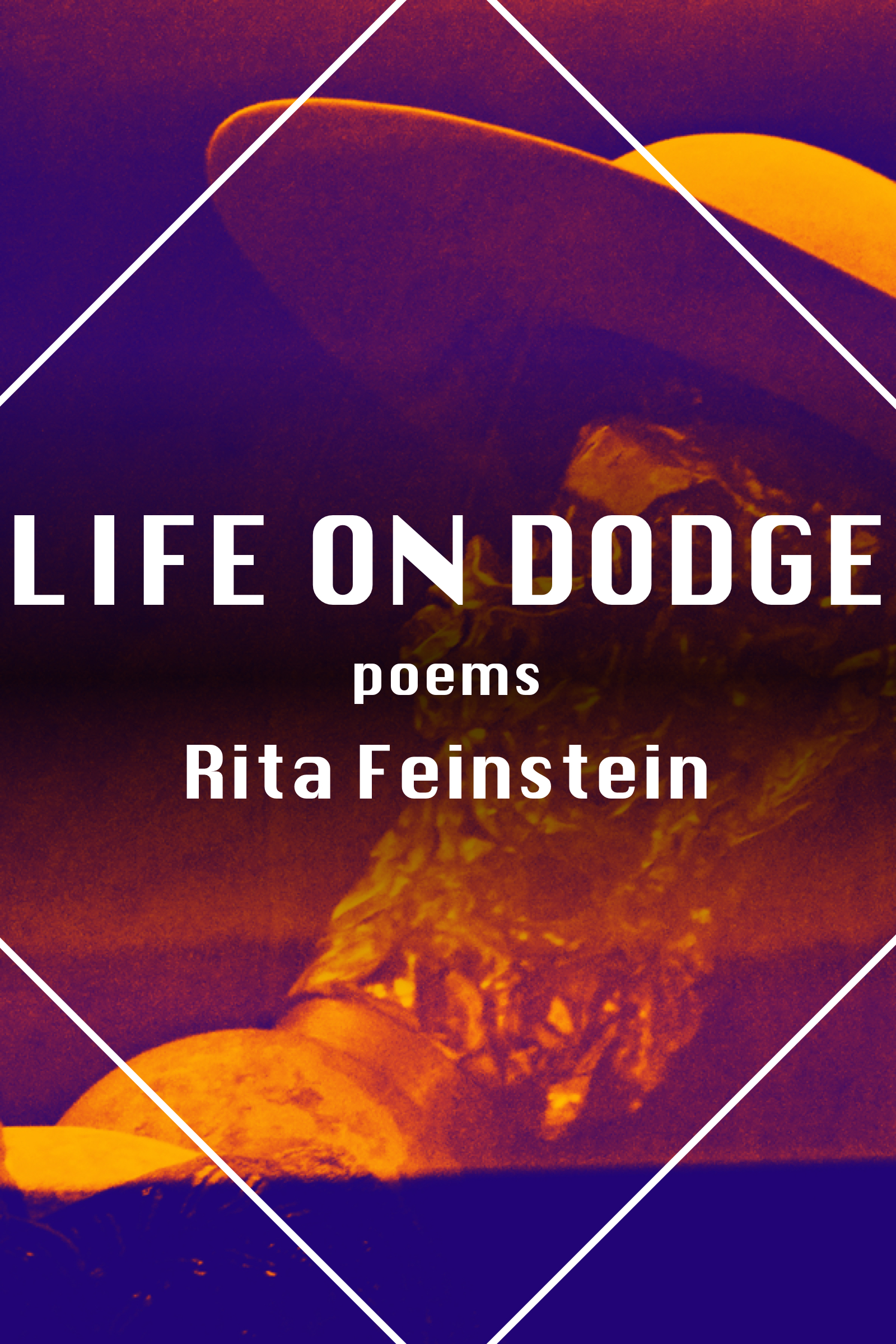
About Life on Dodge

Life on Dodge is a generous gift to the broken-hearted, a romp through an interstellar garden with the best of guides. —Kiki Petrosino, author of Witch Wife

I realize that being a woman is a lot / like being a planet—I can’t decide / what my gravity attracts. I am as helpless / as I am powerful.

Poet Rita Feinstein builds a planet from twenty-five sonnets of lost love, and the astrophysics is undeniable. What has more gravitational pull than loss? What is a more alien landscape than the rearrangement of a heart?

A strong narrative arc built from verse, Feinstein’s debut collection crosses Shakespeare with science fiction to launch readers into a world apart where a newly broken heart is celebrated, examined, nurtured, and let to rage, as if only the atmosphere of an entirely new planet is able to bear the process of healing. This emotionally generous collection looks at pain and lovefourteen crystalline and confessional lines at a time. Dodge, as the speaker names her planet, “is not Virginia.” It is “red because a horse heart / is red . . . Red because / that’s what I was wearing when I left,” and as the speaker fills Planet Dodge with men (because “there’s no reason for Dodge / to be this empty”), she finds “how easy it is to hate them all / after six years of loving you too much.”

Life on Dodge is a powerful cycle of confessional verse,  a contemporary radio signal to Plath and Sexton, utterly unafraid of the heat and danger of reentry after the fully interstellar escape that comes after heartbreak. “Next month the pain will be less, / and the next month it will simply disappear. / For example: today you are coming to Dodge. / You are coming to take me home.”

A Selection from Life on Dodge

When you left, there was a sound

like the scraping of a dagger

being unsheathed from my heart,

and in the left-behind hollow,

a red bat came to roost.

Good, I thought, because bats go

where moths go and moths go

where the light is, which means

there’s still something like a streetlamp

in me, however dusty and guttering.

But where its corona bleeds to black,

you can still hear it—the sleek shriek

of steel against bone, the infinite echo

of you pulling away.

National Poetry Month

BMP Celebrates National Poetry Month — Break Poetry Open

For this year’s National Poetry Month, Brain Mill Press & Voices want to add to your #TBR pile, sing siren songs of unsung heroes, and signal boost living poets we should be reading more. By the end of the month, we hope you will have acquired 30+ new books of poetry and that they continue to multiply in the darkness of your library. Explore new voices & new forms — re-read some old favorites — play if you liked this poet, you’ll like... the old-fashioned way, algorithm-free — just poetry lovers talking to poetry lovers, as the Universe intended. Happy #NaPoMo2019 from Brain Mill Press.

Dear TC Tolbert

One thing I love about you and your work is that it doesn’t shy away from the joy of expressing joy and a kind of love that meets the stranger on the path with a big smile and open arms.

I am not being eloquent. I just had to spell-check the word eloquent. I grew up without books, in a home where books were viewed with suspicion, but even more than suspicion, total neglect. So were children. I was a child in a house with no books and adults who were hurting and angry and left plumes of violent hurt and anger all over the house, in the rooms, and who roped me in with it and wouldn’t let go.

I grew up scared and then angry and then full of a fight that was both a curse and a gift. I spent a long time trying to fix myself. This is a love letter to you, not me, though! Except—you’d want it to be to me, too. That’s what I got from you and your work.

I don’t even remember exactly when I found you or the first poem or how. I’m pretty sure it was when my son, Elliot came out as trans the second time. The first time he told me, I don’t remember it, but he says he was eight and I guess I didn’t hear him or understand. I wanted to be a good mother. I was so overjoyed with my children and I felt such deep love for them and I was happy to create a home for them that would be a safe place and a haven. I also knew I couldn’t be perfect, because that would put too much pressure on my kids and I’d fall right back into the narcissistic traps of it being all about me. Am I being narcissistic now? How’d I get from Elliot to MY children to ME? This is all to say that I think the self exists on a spectrum between toxic narcissism and healthy self-love and grace all in between and around like a desert. Not a wasteland. The desert is teeming with life and beauty. I feel this wondering about the self and its capacity for violence and harm in your work, too. But also that grace for others and the self.

I feel this wondering about the self and its capacity for violence and harm in your work, too. But also that grace for others and the self.

So I missed something Elliot tried to tell me when he was eight. Then he told me again at fifteen and I was still a little wary. But he said LISTEN TO ME, MOM. and I did. I turned to face him and I listened and I said yes to everything in him. He was and is so beautiful. Now he is at the University of Iowa, and when I see him sometimes for lunch or when he texts me or calls, my heart jumps and I feel so happy. He is the most beautiful being.

One of the first books I got immediately after he spoke to me and I listened with an open heart was Troubling the Line. I wanted to be a good mom, so of course, I ordered a bazillion books on being trans the next day: nonfiction, self-help, clinical/academic, fiction, memoir, and poetry.

That’s where I found you. I’m certain of it now. I then signed us up for a poetry workshop at Naropa. I got Elliot in the LAST SPOT for Eileen Myles’ workshop. I took Thurston Moore’s workshop because he was my childhood idol and I wanted to confront him (with grace) for a certain patriarchy I grew up with in the punk scene and kind of felt annoyed at (“Kill Yr Idols”). (I ran away from home as a teenager and found a home in punk rock and poetry.) And I thought meeting you and talking to you outside of a class face to face would be a really meaningful way to connect with you. So Elliot and I met you at SNARFBURGER and I was both beaming at Elliot and doing the proud mother thing and also spilling my soul all over your space. I bought Gephyromania.

You exuded light, just like your poems did. You talked about grace and you spoke the language of my childhood religion in a way that liberated the language from its terror and transformed it into this authentic questioning—the kind of question mark that the wise sages say we should live in. You made space in your workshop (which Elliot and I got to sit in on one day) to dance in the question. Literally, dance, move, embody! I was so scared of my body. So scared of myself, still, after forty-something years, still a scared little girl who wanted to be a brave and loved little boy, and now I had a trans son and he was a blazing light and I was immersed in all this light and felt both overjoyed and fearful, too, in turns.

You exuded light, just like your poems did. You talked about grace and you spoke the language of my childhood religion in a way that liberated the language from its terror.

Look, I know this doesn’t sound academic and like the proper kind of intellectual level of critique and analysis—but I’ve never been able to pull that off. I once wrote a paper about post-structuralism that was just gibberish repeating “signifier and signified” over and over again in every other sentence. I got an A+ but what I really loved in that class was my professor, Lydia Gasman, who survived the Holocaust and would quote Kabbala before class. I loved her.

I love you. Not in a creepy, stalkerish way. The world is dangerous and you’ve got to have good boundaries and sometimes survivors of abuse have trouble with boundaries, which can be a curse but also a GIFT. Because sometimes you meet fellow survivors and they’ve been through so much bullshit they’re like, can we just be real with each other? Like, we’re all going to die, so can we just love each other and mostly extend grace, unless someone proves to be harmful—in which case you have a right to protect yourself. But I just felt like my soul recognized you, first in your poems and then in your self. So whether I ever see you again, face to face, I think of you as a friend in the space of the world. The big beautiful desert and you’re out there blooming.

I just felt like my soul recognized you, first in your poems and then in your self… I think of you as a friend in the space of the world. The big beautiful desert and you’re out there blooming.

I want to be real with everyone I encounter on this big blue planet with its vast deserts of air and light and rocks and blooms. I really do love you all the poets reading and want to meet you and be open to you. If I can break the fourth wall a second and speak directly to the audience reading this—TC is an EMT!!! TC literally meets people in their most broken, scared places and tends to them and always has, in workshops, on the page, in dance, in the wilderness with Outward Bound, with my son, with students, friends, and strangers. Let’s all do that, please, to the best of our ability with all our crankiness or fears or suspicion (born rightfully by our experiences). Let’s be brave and love each other and extend one another grace.

Here’s one of my favorite poems of TC:

What Space Faith Can Occupy

By TC Tolbert

I believe that witness is a magnitude of vulnerability.
That when I say love what I mean is not a feeling
nor promise of a feeling. I believe in attention.
My love for you is a monolith of try.

The woman I love pays an inordinate amount
of attention to large and small objects. She is not
described by anything. Because I could not mean anything else,
she knows exactly what I mean.

Once upon a time a line saw itself
clear to its end. I have seen the shape
of happiness. (y=mx+b)
I am holding it. It is your hand.

[/et_pb_text][/et_pb_column][/et_pb_row][/et_pb_section]

About Heathen Derr-Smith

Heathen/Heather Derr-Smith is a punk rock Sufi genderqueer poet with four books of poetry. s(he) lives in Des Moines with (he)r family of beautiful human beings and dog and cat animal-people. Heather’s most recent book Thrust, won the Lexi Rudnitsky Editor’s Choice Award and was published in 2017 at Persea Books. Derr-Smith is also the founder/director of the nonprofit Cuvaj se, supporting writers in conflict zones and post-conflict zones and communities affected by violence and trauma. So, you may find Heathen wandering around the United States, Ukraine, Bosnia-Herzegovina, or Kurdistan walking beside survivors and resisting authoritarian and fascist bullshit.

National Poetry Month

BMP Celebrates National Poetry Month — Break Poetry Open

For this year’s National Poetry Month, Brain Mill Press & Voices want to add to your #TBR pile, sing siren songs of unsung heroes, and signal boost living poets we should be reading more. By the end of the month, we hope you will have acquired 30+ new books of poetry and that they continue to multiply in the darkness of your library. Explore new voices & new forms — re-read some old favorites — play if you liked this poet, you’ll like... the old-fashioned way, algorithm-free — just poetry lovers talking to poetry lovers, as the Universe intended. Happy #NaPoMo2019 from Brain Mill Press.

Dear TC Tolbert

Heathen Derr-Smith

Dear TC,

I’m thinking of a photograph of a cactus blooming in the desert.

That is always the way I will think of you and your work. It has nothing to do with any kind of cliché of prickliness, because I have never seen a sharp point to you. Maybe you have sharp points like most of us do, but that is certainly not a feature of your spirit or your work. The cactus is full of life. It is green, so green. It curves in a perfect vessel which soothes and delights the lost, the thirsty, the weary. Maybe this sounds over-the-top or sycophantic (God I hope not) but one thing I love about you and your work is that it doesn’t shy away from the joy of expressing joy and a kind of love that meets the stranger on the path with a big smile and open arms. Sometimes people doubt it when a person shows up that way—maybe people have been hurt and are suspicious and maybe cynical. But I mean it, I see you and your work this way—like a vessel full of life and light.

One thing I love about you and your work is that it doesn’t shy away from the joy of expressing joy and a kind of love that meets the stranger on the path with a big smile and open arms.

I am not being eloquent. I just had to spell-check the word eloquent. I grew up without books, in a home where books were viewed with suspicion, but even more than suspicion, total neglect. So were children. I was a child in a house with no books and adults who were hurting and angry and left plumes of violent hurt and anger all over the house, in the rooms, and who roped me in with it and wouldn’t let go.

I grew up scared and then angry and then full of a fight that was both a curse and a gift. I spent a long time trying to fix myself. This is a love letter to you, not me, though! Except—you’d want it to be to me, too. That’s what I got from you and your work.

I don’t even remember exactly when I found you or the first poem or how. I’m pretty sure it was when my son, Elliot came out as trans the second time. The first time he told me, I don’t remember it, but he says he was eight and I guess I didn’t hear him or understand. I wanted to be a good mother. I was so overjoyed with my children and I felt such deep love for them and I was happy to create a home for them that would be a safe place and a haven. I also knew I couldn’t be perfect, because that would put too much pressure on my kids and I’d fall right back into the narcissistic traps of it being all about me. Am I being narcissistic now? How’d I get from Elliot to MY children to ME? This is all to say that I think the self exists on a spectrum between toxic narcissism and healthy self-love and grace all in between and around like a desert. Not a wasteland. The desert is teeming with life and beauty. I feel this wondering about the self and its capacity for violence and harm in your work, too. But also that grace for others and the self.

I feel this wondering about the self and its capacity for violence and harm in your work, too. But also that grace for others and the self.

So I missed something Elliot tried to tell me when he was eight. Then he told me again at fifteen and I was still a little wary. But he said LISTEN TO ME, MOM. and I did. I turned to face him and I listened and I said yes to everything in him. He was and is so beautiful. Now he is at the University of Iowa, and when I see him sometimes for lunch or when he texts me or calls, my heart jumps and I feel so happy. He is the most beautiful being.

One of the first books I got immediately after he spoke to me and I listened with an open heart was Troubling the Line. I wanted to be a good mom, so of course, I ordered a bazillion books on being trans the next day: nonfiction, self-help, clinical/academic, fiction, memoir, and poetry.

That’s where I found you. I’m certain of it now. I then signed us up for a poetry workshop at Naropa. I got Elliot in the LAST SPOT for Eileen Myles’ workshop. I took Thurston Moore’s workshop because he was my childhood idol and I wanted to confront him (with grace) for a certain patriarchy I grew up with in the punk scene and kind of felt annoyed at (“Kill Yr Idols”). (I ran away from home as a teenager and found a home in punk rock and poetry.) And I thought meeting you and talking to you outside of a class face to face would be a really meaningful way to connect with you. So Elliot and I met you at SNARFBURGER and I was both beaming at Elliot and doing the proud mother thing and also spilling my soul all over your space. I bought Gephyromania.

You exuded light, just like your poems did. You talked about grace and you spoke the language of my childhood religion in a way that liberated the language from its terror and transformed it into this authentic questioning—the kind of question mark that the wise sages say we should live in. You made space in your workshop (which Elliot and I got to sit in on one day) to dance in the question. Literally, dance, move, embody! I was so scared of my body. So scared of myself, still, after forty-something years, still a scared little girl who wanted to be a brave and loved little boy, and now I had a trans son and he was a blazing light and I was immersed in all this light and felt both overjoyed and fearful, too, in turns.

You exuded light, just like your poems did. You talked about grace and you spoke the language of my childhood religion in a way that liberated the language from its terror.

Look, I know this doesn’t sound academic and like the proper kind of intellectual level of critique and analysis—but I’ve never been able to pull that off. I once wrote a paper about post-structuralism that was just gibberish repeating “signifier and signified” over and over again in every other sentence. I got an A+ but what I really loved in that class was my professor, Lydia Gasman, who survived the Holocaust and would quote Kabbala before class. I loved her.

I love you. Not in a creepy, stalkerish way. The world is dangerous and you’ve got to have good boundaries and sometimes survivors of abuse have trouble with boundaries, which can be a curse but also a GIFT. Because sometimes you meet fellow survivors and they’ve been through so much bullshit they’re like, can we just be real with each other? Like, we’re all going to die, so can we just love each other and mostly extend grace, unless someone proves to be harmful—in which case you have a right to protect yourself. But I just felt like my soul recognized you, first in your poems and then in your self. So whether I ever see you again, face to face, I think of you as a friend in the space of the world. The big beautiful desert and you’re out there blooming.

I just felt like my soul recognized you, first in your poems and then in your self… I think of you as a friend in the space of the world. The big beautiful desert and you’re out there blooming.

I want to be real with everyone I encounter on this big blue planet with its vast deserts of air and light and rocks and blooms. I really do love you all the poets reading and want to meet you and be open to you. If I can break the fourth wall a second and speak directly to the audience reading this—TC is an EMT!!! TC literally meets people in their most broken, scared places and tends to them and always has, in workshops, on the page, in dance, in the wilderness with Outward Bound, with my son, with students, friends, and strangers. Let’s all do that, please, to the best of our ability with all our crankiness or fears or suspicion (born rightfully by our experiences). Let’s be brave and love each other and extend one another grace.

Here’s one of my favorite poems of TC:

What Space Faith Can Occupy

By TC Tolbert

I believe that witness is a magnitude of vulnerability.
That when I say love what I mean is not a feeling
nor promise of a feeling. I believe in attention.
My love for you is a monolith of try.

The woman I love pays an inordinate amount
of attention to large and small objects. She is not
described by anything. Because I could not mean anything else,
she knows exactly what I mean.

Once upon a time a line saw itself
clear to its end. I have seen the shape
of happiness. (y=mx+b)
I am holding it. It is your hand.

About Heathen Derr-Smith

Heathen/Heather Derr-Smith is a punk rock Sufi genderqueer poet with four books of poetry. s(he) lives in Des Moines with (he)r family of beautiful human beings and dog and cat animal-people. Heather’s most recent book Thrust, won the Lexi Rudnitsky Editor’s Choice Award and was published in 2017 at Persea Books. Derr-Smith is also the founder/director of the nonprofit Cuvaj se, supporting writers in conflict zones and post-conflict zones and communities affected by violence and trauma. So, you may find Heathen wandering around the United States, Ukraine, Bosnia-Herzegovina, or Kurdistan walking beside survivors and resisting authoritarian and fascist bullshit.

National Poetry Month

BMP Celebrates National Poetry Month — Break Poetry Open

For this year’s National Poetry Month, Brain Mill Press & Voices want to add to your #TBR pile, sing siren songs of unsung heroes, and signal boost living poets we should be reading more. By the end of the month, we hope you will have acquired 30+ new books of poetry and that they continue to multiply in the darkness of your library. Explore new voices & new forms — re-read some old favorites — play if you liked this poet, you’ll like... the old-fashioned way, algorithm-free — just poetry lovers talking to poetry lovers, as the Universe intended. Happy #NaPoMo2019 from Brain Mill Press.

The Turf Chick

Poetry Month Spotlight

The Turf Chick

Some said I was the female Pac, Some said I was the female Biggie, some said I was the female Rick, and some said rappers can’t mess with me

–The Turf Chick, Untitled

I get up every day with a new goal on my mind, the same frown and the same broken spirit from doors opening and shutting right before my eyes. It feels like I’m working overtime. Overtime with no pay.

Some days I just want to give up and live a regular life, you know? Go to work, pay rent, and enjoy the rest of my funds doing the things that excite me.

But no. I was given the gift of song, and no matter how much I try to be normal, my soul releases words that move the world!

Music is the only reason I am still alive. You get me? Being a homosexual and a woman and, I may sound cocky, but extremely talented — better than some who are very well established — it’s hard! It’s hard to prove a point. It’s easy to make you listen, but when men see me they realize I’m good for nothing because they can’t get anything out of me in exchange for a deal.

Sometimes I hate being a woman. You can tell, right? Sometimes I wish I wasn’t used as a sex symbol, used to get the things I work so hard for in life. Coming up in the music industry is tough, because you have to have the mind of shark and the heart of a beast! But the soul of pure woman. Give yourself away or work harder with the same amount a faith after every door has been slammed in your face for being a woman in the music industry.

Honestly at this point I don’t wonder when I’m going to make it or when I’m going to finally get through that door… All I want to know is, when are people actually going to listen. Before they look.

On 2229

When everything was all alright, and momma held my head when I cried on 2229, I watched my brother come in and out of jail thinking how he get that phone in his cell.

On 2229

–The Turf Chick, “2229“

The realest people crossed me and now they’re fake as ever so I’m ready for whatever

–The Turf Chick, “Whateva”

I never knew my day ones, wasn’t really there for me, they wanted my dream and everything that came with it, all us eating living life was the plan for me.

–The Turf Chick, “FearFull”

About The Turf Chick

Local rising star Gabrielle Gilbert, who goes by the stage name of “The Turf Chick,” was born in East Palo Alto and raised in Sacramento since age eleven. In the beginning, Gabrielle Gilbert, with the childhood nickname “Gi-Gi” performed for her brothers, sisters, and cousins. When she was only thirteen years old, she made her first recording at a friend’s studio in South Sacramento, rapping “I GO.” From then, Gi-Gi became “The Turf Chick,” writing and rapping messages of hope, street life, and personal struggles. Inspired by music icons Lil Kim, Messy Marv, MC Lyte, Queen Latifah, and Eve, Gabriel says her fans best describe her music as “urban and underground hip-hop with a mix of hard-core bursting lyrics.” The Turf Chick was the only solo hip hop performer at the 2007 Hub Choice Awards in Sacramento, performing in front of nearly 1,200 people.

Twitter | Instagram | Soundcloud | YouTube

National Poetry Month

BMP Celebrates National Poetry Month 2016

If “love calls us to the things of this world,” then poetry too can call us to think about challenging questions, difficult situations, and social justice, implicating and engaging the reader with the world we live in, in the hope that this engagement is a step toward wrestling with our better selves.

I Know Why Anne Sexton Had to Die

I Knox Why Anne Sexton Had to Die

Jen Escher

Before the dichotomously empathetic, accusatory, and self-assigned label “Daddy Issues” and before my cruelly whispered / screamed / graffitied high school nickname “slut” or “whore” emerged, there was a much gentler label stamped on me — “Boy Crazy.”

When I was small, I would sit on my grandpa’s lap on the rough plaid fabric-covered couch my grandma referred to as the davenport. Through the blue haze of cigarette smoke — from my chain-smoking grandmother in her recliner and my grandfather’s vanilla-scented tobacco pipe — we would watch Dragnet and M.A.S.H. until it was time for me to go to bed. Grandpa would share his sardines and crackers with me and Grandma would growl under her breath for us to watch our crumbs. When a commercial came on and I would get fidgety, Grandpa would grab onto my knee with his callused hand and squeeze.

“Are you boy crazy?” he would ask. “If you laugh you are.” Being extremely ticklish, I would laugh until I couldn’t breathe. “Wow!” Grandpa would say. “You are the most boy crazy little girl I have ever seen. We’ll have to lock this one up, Mama,” he would say to Grandma who would scold us. “Quiet down now! The show is back on!” In hindsight, I realize that innocent little game significantly molded my budding self-perception.

Until I was well into my final years of grade school, I genuinely believed that Grandpa had squeezed out some genetic material that made me boy crazy. He had squeezed that spot so hard that it had sent some unidentifiable slut fluid coursing through my body and into my brain. It was the only way I could explain why I was so curious about sex. Why, at the age of six, I would sneak boys out to the tree belts on the base to show them my Wonder Woman Under-Roos and ask them if they wanted to touch me on my privates. Why, from fourth grade on, I would get in trouble for writing dirty stories in class — romantic and passionate scenes of being kissed and fondled against the seventh-grade lockers. Why, in kindergarten, the Larson twins were not allowed to play with me anymore after their mother found us behind the garage where I made them take turns kissing me. Why, at twelve, I let the neighbor boy (who was five years older than me) finger me in the basement of an empty base housing unit while his mother, my babysitter, cleaned the walls with bleach upstairs.

The phrase “Daddy Issues” is a repurposed, Urban Dictionary version of Jung’s Electra Complex, a counter to Freud’s Oedipus Complex. Jung theorized that girls are in competition to fuck their fathers and remove their mothers from the equation — through matricide in the case of Electra. Generation X, in its infinite introspective narcissism, coined “Daddy Issues” as a way to explain promiscuous behavior in women who had bad or nonexistent relationships with their fathers. The belief is that these lost girls are seeking the love they did not receive at home through sexual relationships with men. Sadly, I fit the criteria for this over-the-counter diagnosis.

The obvious double standard implied here is that for a woman to pursue sex there must be something psychologically wrong with her; only men are allowed to seek out sexual gratification in excess without being labeled as mentally ill. To be fair, there is often a psychological catalyst behind promiscuity, but I believe this applies to men as well. People do enjoy sex for the sex’s sake. Endorphins are released with orgasm. One cannot deny sex’s addictive qualities on a purely physiological level. If it didn’t feel good, our species would die out. But there is a huge psychological aspect that lands more in the laps of women than of men. When I have engaged in conversations with women over the years, self-proclaimed sluts or just plain lovers of sex, I am seldom told that they just like the physical feeling of sex. There is almost always emotional currency of some kind, whether it is love, power, validation of their attractiveness, or attention. It is unusual for me to meet a woman who claims to be in it for the orgasm. To be blunt, very few women seem to get that from a superficial sexual encounter anyway.

In my teen years, I did not have the presence of mind to understand the more complex psychological motivations behind my promiscuous behavior. I just wanted to be loved. I was in love with love. It was that simple. And I had discovered by the age of nine — through a bad experience with a pedophile which should only be spoken of in the sanctity of a psychologist’s office — that it was not through a man’s stomach that one reached a man’s heart, but through his dick. It may not have been a conscious or verbalized knowledge then, but it was knowledge nonetheless. It was a knowledge based on experience, the kind of knowledge that sticks like tar.

My whole life has been an epic quest for love through sex. Like the story of Cinderella, which I related to so strongly as a child, I have scoured the land for the man who fit most perfectly into my proverbial glass slipper. I never really distinguished between lust and love until I was well into my thirties. And even now, at forty-one, I don’t know that I have completely figured it out. When I see an elderly couple holding hands on a park bench, I sob uncontrollably. I yearn for that kind of love, but when I get it, I struggle to maintain it in the long term.

I have been spoken for from the age of fourteen to present. Engaged, married, married — and never content past the ten-year mark. My quest for love continues even in the sanctity of my relationships. I have left men sobbing in my wake, much like my fathers and my first few lovers left me. I enter and leave every relationship with new criteria.

  1. Just love me. Check!
  2. Don’t be abusive or controlling. Check!
  3. Don’t be an alcoholic and have gainful employment. Check!
  4. Call me out on my shit (kindly) and share experiences with me. Check!

I am forever evolving past my partners, making it impossible to maintain a relationship once I believe it has reached stagnation.

Is this Daddy Issues? Am I still Boy Crazy? Am I an aging slut? Or is it unreasonable for one to promise to love someone forever? Am I evolving as a woman — my needs ever changing and growing — or I am blindly repeating a cycle set forth by sexual abuse in early life? Am I just a slave to my own desires / novelty / fairytale love? Is the image that I have in my head of that elderly couple holding hands on the park bench merely my middle-aged mind’s version of Cinderella?

These are the questions that keep me up at night. Guilty tears running into my ears as I listen to the soft snore of my husband sleeping next to me. He’s a hopeless romantic. The man most likely to hold my wrinkled hand as I lay dying. And yet, here I am again, my love expiring. I’m contemplating a way out.

*This piece contains excerpts from “Boy Crazy” by Jen Escher.

About Jen Escher

Jen Escher is an adjunct English professor and a writer of memoir, poetry, and thinly veiled memoir touted as fiction. She lives in Fond du Lac, Wisconsin (in a quickly emptying nest), where she cheerfully writes about the dark, dense, and complicated human magic that is love, sex, and self-destruction.

National Poetry Month

BMP Celebrates National Poetry Month 2016

If “love calls us to the things of this world,” then poetry too can call us to think about challenging questions, difficult situations, and social justice, implicating and engaging the reader with the world we live in, in the hope that this engagement is a step toward wrestling with our better selves.