“A Young Girl Pares Fruit,” “You Gotta Let It Hit the Skin,” “Like a Poor Girl,” and “Oyinbo Banana”

Editors' Choice Poems

“A Young Girl Pares Fruit,” “You Gotta Let It Hit the Skin,” “Like a Poor Girl,” and “Oyinbo Banana”

We’d also like to acknowledge excellent work by poets Holly Mancuso, Aby Macias, and Brittany Adames.

We hope you’ll enjoy these editors’ picks as much as we did.

A Young Girl Pares Fruit

by Brittany Adames

About Brittany Adames

Brittany Adames is an eighteen-year-old Dominican-American writer. Her work has been previously published in CALAMITY Magazine, Bombus Press, Rumble Fish Quarterly, TRACK//FOUR, and Rust+Moth, among others. She is pursuing a major in creative writing at Emerson College and serves as the poetry editor for Ascend Magazine and prose reader for The Blueshift Journal. She has been regionally and nationally recognized by the Scholastic Writing Awards.

National Poetry Month

You Gotta Let It Hit the Skin

by Shirley Jones-Luke

About Shirley Jones-Luke

Shirley Jones-Luke is a poet and a writer of color. Ms. Luke lives in Boston, Mass. She has an MA from UMass Boston and an MFA from Emerson College. Her work mixes poetry with memoir. Shirley was a Poetry Fellow at the 2017 Watering Hole Poetry Retreat. She will be attending VONA (Voices of Our Nation) in June 2018.

National Poetry Month

Like a Poor Girl

by Mira Martin-Parker

I wear my jewelry like a poor girl—large and real. I wear my clothes like a poor girl—cleaned and ironed. My whites are always whiter that white and I’m always de-linting myself when I wear black. There’s not a spec of dirt or fuzz on my sweaters. Like a poor girl, I am self-conscious at formal tables. I lose my tongue. I don’t order beer. Like a poor girl I read Dostoyevsky on the train. Because, like a poor girl, I have over educated myself. I am like a poor girl when I get my paycheck. I spend it all at once, down to my last ten dollars. I cannot save a thing. For, like a poor girl there are so many things I need, like a cashmere coat, tailor-made in North Beach, with silk lining and antique buttons. And it’s impossible for me to imagine going without wine from the wine shop, fresh baked bread, and organic produce, since like a poor girl, I must have the best of everything. My desk at work is always clean, my bathroom at home is spotless—I bleach each mold spot when it first appears. Like a poor girl, I live in the best city, in a lovely neighborhood, in a darling apartment. But in spite of all that I do, like a poor girl, nothing works, and it’s always apparent right away to everyone that I am a poor girl, and like the poor girl that I am I can’t help looking into the windows of Boulevard restaurant as I pass by on my lunch break, even though I tell myself that there’s nothing to look at inside but white people eating delicate portions of salmon and tossed greens and drinking glasses of wine. Still, I can’t help but look in at them—especially the men—because deep inside I will always be, just like a poor girl.

About Mira Martin-Parker

Mira Martin-Parker earned an MFA in creative writing at San Francisco State University. Her work has appeared in various publications, including the Istanbul Literary Review, North Dakota Quarterly, Mythium, and Zyzzyva. Her collection of short stories, The Carpet Merchant’s Daughter, won the 2013 Five [Quarterly] e-chapbook competition.​

Oyinbo Banana

by Uche Ogbuji

Who said they brought Magilla from Congo bush? Na lie! Saint Lumumba himself showed me His New York City stomping grounds. That Toby Couldn’t see for Kunta Kinte, though He made hay on claiming President Nonesuch For Kenya. Oh no, this ape of the John Doe Was fabbed in US of A. Republics Are King Kong of their combined simian subjects; This one’s about to eat its Jump Jim Crow.

The 45 speed of 419 scheme Plays like this:

                                   Oh you noble poor, rejects                       From the Merkin Dreamliner, we’re on your team.

Just shave an edge more from your pennies our way And we’ll guarantee a lifetime of C.R.E.A.M. Our magic hat is bringing your jobs back, Bae!

Just need a deposit to get things rolling: Health care, welfare, public housing, let’s just say We’ll trade imploded tax code when we come polling Won’t hurt a bit! Trust us, our fathers made Grand puba, We keep the Illuminati Skeleton key in hock at the lodges, see!

Next to Brazzaville diamonds, to kryptonite For China when we throw cash at the Navy And best believe we’ll serve Mexico right From the get-go. Which brings us to that mob, The refugees and immigrants here to fight You good white people for each and every job.

We got your back, sending them all the fuck back, Skewer those fools on their own shish-kebab Our motto: build a wall; hug a smokestack, Jack!

Stand back from flood of green MAGAmillions The whiteman economy back in black.

It lives on in breathtaking resilience, Lure of big men, with their Beemer Benzes, Their WAGs spa-side touching up their brazilians.

An aspiring eye shutters out all offenses, It winks at junkets to Merry Lagos, Watering down its shock at such expenses.

But should they even think to dump the Negus Problem is, what you vote ain’t what you get; Our ballot box is stuffed—old Cold War threat Cyber-wise realized to come back and break us— Active Measures, comrade. This candidate Is echt Manchu, mind you, he knows no nyet.

He’ll yell: Look! Here comes a caliphate, Then auction off our rivers and our shale. Think we won’t deal to return the Kodiak State? Magilla’s taken the shop: we’re all on sale.


About Uche Ogbuji

Uche Ogbuji, more properly Úchèńnà Ogbújí, was born in Calabar, Nigeria. He lived in Egypt, England, and elsewhere before settling near Boulder, Colorado. A computer engineer and entrepreneur by trade, his poetry chapbook, Ndewo, Colorado (Aldrich Press) is a Colorado Book Award Winner and a Westword Award Winner (“Best Environmental Poetry”). His poems, published worldwide, fuse Igbo culture, European classicism, American Mountain West setting, and Hip-Hop. He co-hosts the Poetry Voice podcast and featured in the Best New African Poets anthology.

On Twitter as @uogbuji.


National Poetry Month

BMP Celebrates National Poetry Month 2018

Maybe you have lines living in you. Maybe you’ve been walking around like the speaker in Maggie Smith’s “Good Bones”: “This place could be beautiful, / right? You could make this place beautiful.” Maybe you’ve been inspired by Isobel O’Hare’s erasures, and have an urge to address some things. Maybe you’ve woken up in the spiked night, with a line swimming out of the deep. Maybe you have a story to tell. Or, maybe you memorized Jericho Brown’s “Colosseum” and have been repeating to yourself: “I cannot locate the origin / Of slaughter, but I know / How my own feels, that I live with it / And sometimes use it / To get the living done . . .”

These poetic efforts have touched me in the last few months, in that strange trigonometry of language, chance, and seeking, that we readers and writers do. Brown’s lines resonated with me, brought me low, and offered something – if not quite comfort, then a kind of recognition.

BMP Celebrates National Poetry Month 2019!

Brain Mill Press Celebrates National Poetry Month 2019

Break Poetry Open

Poetry Contest: Break Poetry Open

Open All April – Fee Free

Send us your poems that challenge what poems are, what poems do, how poems mean. We’re especially interested in new forms, new takes on existing forms, and experimental work, as well as poems that ask us to broaden our definitions of “poetry” in general. We want innovative and inclusive voices, poems no one has written yet, the poems inside you that have been begging to be written.

Submission Guidelines

Please submit 1-3 poems in a single document.

Submissions will be reviewed for suitability by Brain Mill Press staff. You will receive editorial development and feedback on your submitted piece and a contract granting Brain Mill Press the limited right to reproduce your piece on Voices. You will retain all other rights to your work.

Your poetry and profile will be published on bmpvoices.com and promoted on our social media outlets. Your post will contain your headshot and bio, as well as information you may wish to include about recent work and your website and social media links.

Brain Mill Press strongly encourages submissions from people of color, women, LGBTQIA+ writers, First Nations writers, and disabled writers. Please direct inquiries not answered in this call to inquiries@brainmillpress.com.

Prizes

Each week, the Brain Mill Press editors will select one or more submitted poems as the editors’ choice pick(s) for the week. Editors’ choice selections may choose any poetry title from the Brain Mill Press catalog for their prize. In early May, the editors will select a winning poem, and the poet will receive the full collection of Brain Mill Press poetry titles for themselves, as well as a second collection to gift to an organization of their choice.

Dear TC Tolbert

One thing I love about you and your work is that it doesn’t shy away from the joy of expressing joy and a kind of love that meets the stranger on the path with a big smile and open arms.

I am not being eloquent. I just had to spell-check the word eloquent. I grew up without books, in a home where books were viewed with suspicion, but even more than suspicion, total neglect. So were children. I was a child in a house with no books and adults who were hurting and angry and left plumes of violent hurt and anger all over the house, in the rooms, and who roped me in with it and wouldn’t let go.

I grew up scared and then angry and then full of a fight that was both a curse and a gift. I spent a long time trying to fix myself. This is a love letter to you, not me, though! Except—you’d want it to be to me, too. That’s what I got from you and your work.

I don’t even remember exactly when I found you or the first poem or how. I’m pretty sure it was when my son, Elliot came out as trans the second time. The first time he told me, I don’t remember it, but he says he was eight and I guess I didn’t hear him or understand. I wanted to be a good mother. I was so overjoyed with my children and I felt such deep love for them and I was happy to create a home for them that would be a safe place and a haven. I also knew I couldn’t be perfect, because that would put too much pressure on my kids and I’d fall right back into the narcissistic traps of it being all about me. Am I being narcissistic now? How’d I get from Elliot to MY children to ME? This is all to say that I think the self exists on a spectrum between toxic narcissism and healthy self-love and grace all in between and around like a desert. Not a wasteland. The desert is teeming with life and beauty. I feel this wondering about the self and its capacity for violence and harm in your work, too. But also that grace for others and the self.

I feel this wondering about the self and its capacity for violence and harm in your work, too. But also that grace for others and the self.

So I missed something Elliot tried to tell me when he was eight. Then he told me again at fifteen and I was still a little wary. But he said LISTEN TO ME, MOM. and I did. I turned to face him and I listened and I said yes to everything in him. He was and is so beautiful. Now he is at the University of Iowa, and when I see him sometimes for lunch or when he texts me or calls, my heart jumps and I feel so happy. He is the most beautiful being.

One of the first books I got immediately after he spoke to me and I listened with an open heart was Troubling the Line. I wanted to be a good mom, so of course, I ordered a bazillion books on being trans the next day: nonfiction, self-help, clinical/academic, fiction, memoir, and poetry.

That’s where I found you. I’m certain of it now. I then signed us up for a poetry workshop at Naropa. I got Elliot in the LAST SPOT for Eileen Myles’ workshop. I took Thurston Moore’s workshop because he was my childhood idol and I wanted to confront him (with grace) for a certain patriarchy I grew up with in the punk scene and kind of felt annoyed at (“Kill Yr Idols”). (I ran away from home as a teenager and found a home in punk rock and poetry.) And I thought meeting you and talking to you outside of a class face to face would be a really meaningful way to connect with you. So Elliot and I met you at SNARFBURGER and I was both beaming at Elliot and doing the proud mother thing and also spilling my soul all over your space. I bought Gephyromania.

You exuded light, just like your poems did. You talked about grace and you spoke the language of my childhood religion in a way that liberated the language from its terror and transformed it into this authentic questioning—the kind of question mark that the wise sages say we should live in. You made space in your workshop (which Elliot and I got to sit in on one day) to dance in the question. Literally, dance, move, embody! I was so scared of my body. So scared of myself, still, after forty-something years, still a scared little girl who wanted to be a brave and loved little boy, and now I had a trans son and he was a blazing light and I was immersed in all this light and felt both overjoyed and fearful, too, in turns.

You exuded light, just like your poems did. You talked about grace and you spoke the language of my childhood religion in a way that liberated the language from its terror.

Look, I know this doesn’t sound academic and like the proper kind of intellectual level of critique and analysis—but I’ve never been able to pull that off. I once wrote a paper about post-structuralism that was just gibberish repeating “signifier and signified” over and over again in every other sentence. I got an A+ but what I really loved in that class was my professor, Lydia Gasman, who survived the Holocaust and would quote Kabbala before class. I loved her.

I love you. Not in a creepy, stalkerish way. The world is dangerous and you’ve got to have good boundaries and sometimes survivors of abuse have trouble with boundaries, which can be a curse but also a GIFT. Because sometimes you meet fellow survivors and they’ve been through so much bullshit they’re like, can we just be real with each other? Like, we’re all going to die, so can we just love each other and mostly extend grace, unless someone proves to be harmful—in which case you have a right to protect yourself. But I just felt like my soul recognized you, first in your poems and then in your self. So whether I ever see you again, face to face, I think of you as a friend in the space of the world. The big beautiful desert and you’re out there blooming.

I just felt like my soul recognized you, first in your poems and then in your self… I think of you as a friend in the space of the world. The big beautiful desert and you’re out there blooming.

I want to be real with everyone I encounter on this big blue planet with its vast deserts of air and light and rocks and blooms. I really do love you all the poets reading and want to meet you and be open to you. If I can break the fourth wall a second and speak directly to the audience reading this—TC is an EMT!!! TC literally meets people in their most broken, scared places and tends to them and always has, in workshops, on the page, in dance, in the wilderness with Outward Bound, with my son, with students, friends, and strangers. Let’s all do that, please, to the best of our ability with all our crankiness or fears or suspicion (born rightfully by our experiences). Let’s be brave and love each other and extend one another grace.

Here’s one of my favorite poems of TC:

What Space Faith Can Occupy

By TC Tolbert

I believe that witness is a magnitude of vulnerability.
That when I say love what I mean is not a feeling
nor promise of a feeling. I believe in attention.
My love for you is a monolith of try.

The woman I love pays an inordinate amount
of attention to large and small objects. She is not
described by anything. Because I could not mean anything else,
she knows exactly what I mean.

Once upon a time a line saw itself
clear to its end. I have seen the shape
of happiness. (y=mx+b)
I am holding it. It is your hand.

[/et_pb_text][/et_pb_column][/et_pb_row][/et_pb_section]

About Heathen Derr-Smith

Heathen/Heather Derr-Smith is a punk rock Sufi genderqueer poet with four books of poetry. s(he) lives in Des Moines with (he)r family of beautiful human beings and dog and cat animal-people. Heather’s most recent book Thrust, won the Lexi Rudnitsky Editor’s Choice Award and was published in 2017 at Persea Books. Derr-Smith is also the founder/director of the nonprofit Cuvaj se, supporting writers in conflict zones and post-conflict zones and communities affected by violence and trauma. So, you may find Heathen wandering around the United States, Ukraine, Bosnia-Herzegovina, or Kurdistan walking beside survivors and resisting authoritarian and fascist bullshit.

National Poetry Month

BMP Celebrates National Poetry Month — Break Poetry Open

For this year’s National Poetry Month, Brain Mill Press & Voices want to add to your #TBR pile, sing siren songs of unsung heroes, and signal boost living poets we should be reading more. By the end of the month, we hope you will have acquired 30+ new books of poetry and that they continue to multiply in the darkness of your library. Explore new voices & new forms — re-read some old favorites — play if you liked this poet, you’ll like... the old-fashioned way, algorithm-free — just poetry lovers talking to poetry lovers, as the Universe intended. Happy #NaPoMo2019 from Brain Mill Press.

Dear TC Tolbert

Heathen Derr-Smith

Dear TC,

I’m thinking of a photograph of a cactus blooming in the desert.

That is always the way I will think of you and your work. It has nothing to do with any kind of cliché of prickliness, because I have never seen a sharp point to you. Maybe you have sharp points like most of us do, but that is certainly not a feature of your spirit or your work. The cactus is full of life. It is green, so green. It curves in a perfect vessel which soothes and delights the lost, the thirsty, the weary. Maybe this sounds over-the-top or sycophantic (God I hope not) but one thing I love about you and your work is that it doesn’t shy away from the joy of expressing joy and a kind of love that meets the stranger on the path with a big smile and open arms. Sometimes people doubt it when a person shows up that way—maybe people have been hurt and are suspicious and maybe cynical. But I mean it, I see you and your work this way—like a vessel full of life and light.

One thing I love about you and your work is that it doesn’t shy away from the joy of expressing joy and a kind of love that meets the stranger on the path with a big smile and open arms.

I am not being eloquent. I just had to spell-check the word eloquent. I grew up without books, in a home where books were viewed with suspicion, but even more than suspicion, total neglect. So were children. I was a child in a house with no books and adults who were hurting and angry and left plumes of violent hurt and anger all over the house, in the rooms, and who roped me in with it and wouldn’t let go.

I grew up scared and then angry and then full of a fight that was both a curse and a gift. I spent a long time trying to fix myself. This is a love letter to you, not me, though! Except—you’d want it to be to me, too. That’s what I got from you and your work.

I don’t even remember exactly when I found you or the first poem or how. I’m pretty sure it was when my son, Elliot came out as trans the second time. The first time he told me, I don’t remember it, but he says he was eight and I guess I didn’t hear him or understand. I wanted to be a good mother. I was so overjoyed with my children and I felt such deep love for them and I was happy to create a home for them that would be a safe place and a haven. I also knew I couldn’t be perfect, because that would put too much pressure on my kids and I’d fall right back into the narcissistic traps of it being all about me. Am I being narcissistic now? How’d I get from Elliot to MY children to ME? This is all to say that I think the self exists on a spectrum between toxic narcissism and healthy self-love and grace all in between and around like a desert. Not a wasteland. The desert is teeming with life and beauty. I feel this wondering about the self and its capacity for violence and harm in your work, too. But also that grace for others and the self.

I feel this wondering about the self and its capacity for violence and harm in your work, too. But also that grace for others and the self.

So I missed something Elliot tried to tell me when he was eight. Then he told me again at fifteen and I was still a little wary. But he said LISTEN TO ME, MOM. and I did. I turned to face him and I listened and I said yes to everything in him. He was and is so beautiful. Now he is at the University of Iowa, and when I see him sometimes for lunch or when he texts me or calls, my heart jumps and I feel so happy. He is the most beautiful being.

One of the first books I got immediately after he spoke to me and I listened with an open heart was Troubling the Line. I wanted to be a good mom, so of course, I ordered a bazillion books on being trans the next day: nonfiction, self-help, clinical/academic, fiction, memoir, and poetry.

That’s where I found you. I’m certain of it now. I then signed us up for a poetry workshop at Naropa. I got Elliot in the LAST SPOT for Eileen Myles’ workshop. I took Thurston Moore’s workshop because he was my childhood idol and I wanted to confront him (with grace) for a certain patriarchy I grew up with in the punk scene and kind of felt annoyed at (“Kill Yr Idols”). (I ran away from home as a teenager and found a home in punk rock and poetry.) And I thought meeting you and talking to you outside of a class face to face would be a really meaningful way to connect with you. So Elliot and I met you at SNARFBURGER and I was both beaming at Elliot and doing the proud mother thing and also spilling my soul all over your space. I bought Gephyromania.

You exuded light, just like your poems did. You talked about grace and you spoke the language of my childhood religion in a way that liberated the language from its terror and transformed it into this authentic questioning—the kind of question mark that the wise sages say we should live in. You made space in your workshop (which Elliot and I got to sit in on one day) to dance in the question. Literally, dance, move, embody! I was so scared of my body. So scared of myself, still, after forty-something years, still a scared little girl who wanted to be a brave and loved little boy, and now I had a trans son and he was a blazing light and I was immersed in all this light and felt both overjoyed and fearful, too, in turns.

You exuded light, just like your poems did. You talked about grace and you spoke the language of my childhood religion in a way that liberated the language from its terror.

Look, I know this doesn’t sound academic and like the proper kind of intellectual level of critique and analysis—but I’ve never been able to pull that off. I once wrote a paper about post-structuralism that was just gibberish repeating “signifier and signified” over and over again in every other sentence. I got an A+ but what I really loved in that class was my professor, Lydia Gasman, who survived the Holocaust and would quote Kabbala before class. I loved her.

I love you. Not in a creepy, stalkerish way. The world is dangerous and you’ve got to have good boundaries and sometimes survivors of abuse have trouble with boundaries, which can be a curse but also a GIFT. Because sometimes you meet fellow survivors and they’ve been through so much bullshit they’re like, can we just be real with each other? Like, we’re all going to die, so can we just love each other and mostly extend grace, unless someone proves to be harmful—in which case you have a right to protect yourself. But I just felt like my soul recognized you, first in your poems and then in your self. So whether I ever see you again, face to face, I think of you as a friend in the space of the world. The big beautiful desert and you’re out there blooming.

I just felt like my soul recognized you, first in your poems and then in your self… I think of you as a friend in the space of the world. The big beautiful desert and you’re out there blooming.

I want to be real with everyone I encounter on this big blue planet with its vast deserts of air and light and rocks and blooms. I really do love you all the poets reading and want to meet you and be open to you. If I can break the fourth wall a second and speak directly to the audience reading this—TC is an EMT!!! TC literally meets people in their most broken, scared places and tends to them and always has, in workshops, on the page, in dance, in the wilderness with Outward Bound, with my son, with students, friends, and strangers. Let’s all do that, please, to the best of our ability with all our crankiness or fears or suspicion (born rightfully by our experiences). Let’s be brave and love each other and extend one another grace.

Here’s one of my favorite poems of TC:

What Space Faith Can Occupy

By TC Tolbert

I believe that witness is a magnitude of vulnerability.
That when I say love what I mean is not a feeling
nor promise of a feeling. I believe in attention.
My love for you is a monolith of try.

The woman I love pays an inordinate amount
of attention to large and small objects. She is not
described by anything. Because I could not mean anything else,
she knows exactly what I mean.

Once upon a time a line saw itself
clear to its end. I have seen the shape
of happiness. (y=mx+b)
I am holding it. It is your hand.

About Heathen Derr-Smith

Heathen/Heather Derr-Smith is a punk rock Sufi genderqueer poet with four books of poetry. s(he) lives in Des Moines with (he)r family of beautiful human beings and dog and cat animal-people. Heather’s most recent book Thrust, won the Lexi Rudnitsky Editor’s Choice Award and was published in 2017 at Persea Books. Derr-Smith is also the founder/director of the nonprofit Cuvaj se, supporting writers in conflict zones and post-conflict zones and communities affected by violence and trauma. So, you may find Heathen wandering around the United States, Ukraine, Bosnia-Herzegovina, or Kurdistan walking beside survivors and resisting authoritarian and fascist bullshit.

National Poetry Month

BMP Celebrates National Poetry Month — Break Poetry Open

For this year’s National Poetry Month, Brain Mill Press & Voices want to add to your #TBR pile, sing siren songs of unsung heroes, and signal boost living poets we should be reading more. By the end of the month, we hope you will have acquired 30+ new books of poetry and that they continue to multiply in the darkness of your library. Explore new voices & new forms — re-read some old favorites — play if you liked this poet, you’ll like... the old-fashioned way, algorithm-free — just poetry lovers talking to poetry lovers, as the Universe intended. Happy #NaPoMo2019 from Brain Mill Press.

Poetry Month Feature

Poetry Month Spotlight

Rogue Agent

National Poetry Month

BMP Celebrates National Poetry Month 2018

Maybe you have lines living in you. Maybe you’ve been walking around like the speaker in Maggie Smith’s “Good Bones”: “This place could be beautiful, / right? You could make this place beautiful.” Maybe you’ve been inspired by Isobel O’Hare’s erasures, and have an urge to address some things. Maybe you’ve woken up in the spiked night, with a line swimming out of the deep. Maybe you have a story to tell. Or, maybe you memorized Jericho Brown’s “Colosseum” and have been repeating to yourself: “I cannot locate the origin / Of slaughter, but I know / How my own feels, that I live with it / And sometimes use it / To get the living done . . .”

These poetic efforts have touched me in the last few months, in that strange trigonometry of language, chance, and seeking, that we readers and writers do. Brown’s lines resonated with me, brought me low, and offered something – if not quite comfort, then a kind of recognition.

Intimacy and Poetry

Intimacy and Poetry

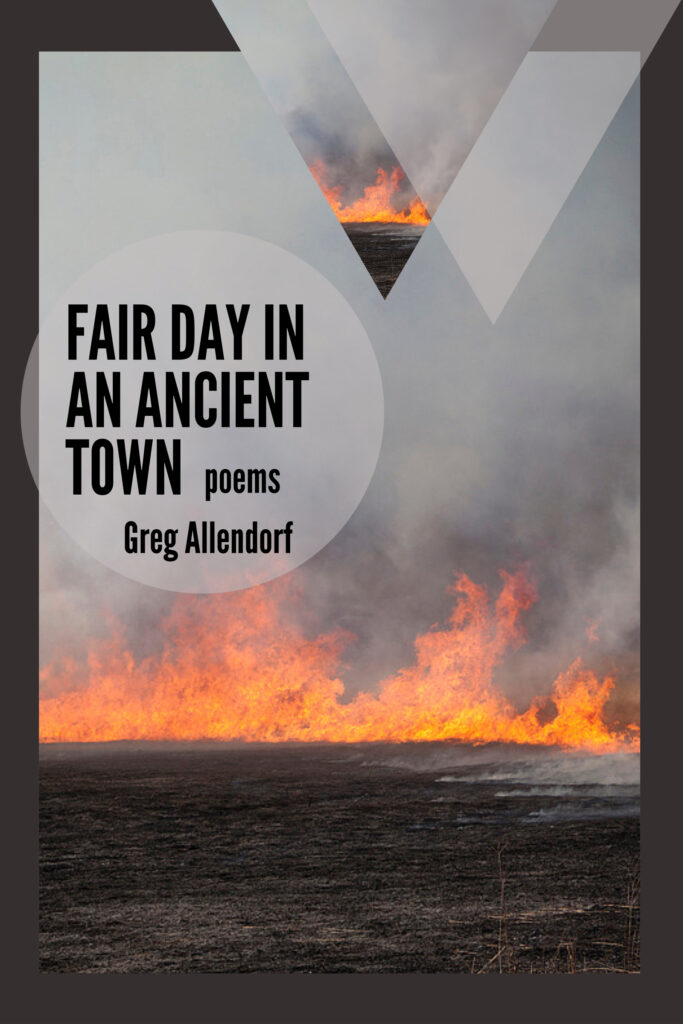
A Conversation about Greg Allendorf

[Greg Allendorf Two-Person Table in the Back Corner of the Coffee Shop, Next to the Fireplace Chat]

I invited fellow fiction writer Liz Jacobs to cozy up to the virtual fireplace with me and chat about Greg Allendorf’s excellent collection, Fair Day in an Ancient Town, for poetry month.

Roan Parrish: We both write fiction that’s invested in love and relationships, and are both poetry enthusiasts (though not experts). As such, I found myself thinking a lot about the role of love and romance when I was reading these poems. I wonder what your thoughts are about how poetry might give us a different language for telling love stories, or a different approach to expressing intimacy?

Liz Jacobs: I think it’s definitely a very different approach. I mean, in romantic, say, fiction, we have to build a story. That’s sort of a simplistic first difference, but poetic structure doesn’t need an arc, not really. I think it just needs a thread. And it creates a sort of … snapshot of a moment, and can certainly tell a story, but that isn’t a must, and it isn’t what we look for in poetry.

Roan: Yes, absolutely. One of the things that I think a lot when I read poetry is how it allows you to burrow into a moment. To really explore and sense everything about that moment. And, for me, often that’s a more … not accurate but useful way to approach romance or romantic feelings. As you say, in fiction, we tend to curate, arrange, place moments in an order that has a teleology, but (of course) feelings don’t actually work that way. I mean, duh, fiction. So, poems seem to have this mode of parallelism with romantic feeling that can open things up in really beautiful ways.

Liz: Yes. And even though, in real life, we are living out our own stories, romantic moments tend to bounce around, and not really have a complete storyline. And what poetry is able to capture is that fleeting sense of it. I really loved “Embellishment upon a Memory of You Eating Blueberries in Your Car” because it does tell a story of sorts—a memory, I suppose—but more than anything else, it captures that sense of loss. The way it zooms out from scene to scene and grabs you. I especially loved the line,

Oranges grow violet molds and stink.

Diagrams curl yellow on the walls.

—”Embellishment upon a Memory of You Eating Blueberries in Your Car” by Greg Allendorf

That’s something you can absolutely put into fiction, but in this poem, it floats in a sublime sort of way. At least to me.

Roan: I agree, and I think that the poem just before it—”We Will Become One In Luxor”—has a similar storytelling mode, though rather than a memory it’s a dream, or a fantasy. It tells the story by imagining a setting for the love that will be. Calling it into being in this place, and then populating it, plotting it, giving it a story. And, of course, neither of us (I don’t think) would ever say that there needs to be any kind of dividebetween fiction and poetry, but it does seem that a poem like this is able to use story in a very different mode. A mode that imagines an entire love affair in one page. The way it’s able to make love that might last a lifetime condensed, or to effortlessly dilate one moment into an entire poem … these are things that I think are most deftly done in poetry.

Liz: Yes, exactly. As I was writing the above, I realized I was accidentally drawing an imaginary line between poetry and prose, something I didn’t necessarily want to do. I loved that poem, too—it was intense and evocative and I sort of wanted to burrow into it for a while because of that. I think what I really loved about this entire collection is how vivid it was. So many gorgeous images and turns of phrase. I tend to read in a micro sort of way, I think—I notice phrases or snippets before I can see the whole picture. I mean, that could be how everyone reads, but with “Luxor” I felt this line so much:

I will see you there in Luxor with your jaw

and earlobes.

–”We Will Become One in Luxor” by Greg Allendorf

It’s so simple and packs so much.

Roan: That line, and others like it that manage to render something so particular though they reference something so general, is something that this collection did so well for me. Like, yup, we’ve all got earlobes and jaws (er, mostly), but just by naming those body parts in the context of other particularities in the collection, brings something universal to such a personal level. Poems often operate on a kind of associative logic that also governs, for me, the way I feel in love or when I’m crushed out on someone. The way everything I see reminds me of them, makes me think of them. So I see the bend of a tree branch and I think THEIR JAW! And it doesn’t need to be something specific that my thoughts latch onto, necessarily, because it’s run through the filter of THIS PERSON. It draws the general and the universal quite close, and writes the tiny and the personal onto the whole world.

Liz: Yes! Yes, exactly that. I think it can be quite challenging in prose to recreate that sense of it. With poetry, you can pull words together in a different way, and Allendorf has a really light hand when it comes to that. His words are so evocative.

And what I really enjoyed about this collection, too, is that it was very much my mistress’ eyes are nothing like the sun. The lover described in this collection is not at all idealized. He is, apparently, not very smart, has an off-putting fake tan … But he is loved by the narrator, or at least the narrator is enamored of him. And that puts such a human lens on it. It also invites the reader to think that they can be loved despite/for their own flaws, because nobody is flawless. Sometimes poetry can be used to … de-flaw, sort of shave off those peccadilloes and round somebody out until they have no definable edge, but this really dove into them, and was a pleasure to read (and made me laugh quite a bit, too).

Roan: I appreciated that too! Allendorf isn’t mean-spirited, either, and he holds up his own participation in the exaltation/unexeptionalization (is this a word? It should be) of the lover from the beginning of the collection. The opening line, “I did the love and dressed for my scant part / in the love,” announces from the start that he’s aware of the way loving is part participation in something less perfect, less romanticized, than paeans often suggest. He’s complicit in the affair that’s about to take place in the poems to follow—complicit in the loving, but also in the flaws of loving.

The next line is “As I escape my cheap / dress shirt, crystal flies embellish me.” The costume of the lover is as ornamented as the ideas of love, and he’s super up front about its paste.

Liz: Yes, absolutely. The “we” in “Good Shepherds” is also suggestive of that—that complicity on the part of each lover, and then the “I” at the end is separated from “he” and they are decoupled.

In “Catamount,” the couplet was so striking:

I hate couplets, I hate couples, hate

the tension our avulsion can create

–”Catamount” by Greg Allendorf

Amusing, yes, but also that sense of being pulled into something you can’t control. I guess we could look at it as the other side of being complicit in love.

Roan: I’m so glad you bring up “Catamount”; I was delighted by that line! It also feels like this very striking way of imagining what love can become when we enshrine it: a beautiful wild thing, “Once-feared, now dry and glass-eyed and open- / faced on an oak plaque in my rich den.” This idea that we render something living pure ornament when we attempt to capture it, hold it still.

And it’s such a fitting thing for a writer to meditate on, because that’s what the poem is doing, essentially: attempting to find a way for language to gallop at the speed of love. “I shine you with Armor All and pace / behind the blackened window flanked with lace.” The struggle of doing more than just pointing at love and screaming into the void of the white page, “LOOK! IT’S LOVE!” I mean, I’m not going all language is dead things splayed out on the page or anything, but it’s certainly something I think all writing contends with. And, for me, it’s the beauty of the words themselves that is able to tip the scales to the side of art as being meaningful in that struggle.

Liz: Yes. Language is a living thing, but it is interesting to think how it guides us in our everyday life versus in the purposeful creation of art, for instance. (See how I decided that life can be art, too? *scuffs toes*)

Roan: Yes, we must believe this, no?  As we’ve started to get at, Fair Day in an Ancient Town has legs in both the ancient and the modern, the exalted and the banal, the formal and the formless, and all of these modes are used to characterize the beloved. In this, it reminded me a bit of Mark Wunderlich’s work, which I also love. I wonder what effect this mixture has on the way the collection frames love?

Liz: I’m an incredibly visual person, so I got a little thrill about turning to pages 18 and 19 and seeing a poem that looks like a cape or a waterfall. That really tickled me. I love that it goes from couplets to more dense forms. There was even a sneaky sonnet, which I adored.

Roan: Me too! I’m no scholar of contemporary poetry, so clearly this is quite broad strokes, but while for a time modern poetry was asserting itself against formal poetry by turning away from established forms entirely, more recently folks have been reclaiming form in ways that are making it quite relevant again. And in a collection that combines the modern and the less modern, that use of forms and their disruption felt particularly potent to me. And with regard to romance, there’s something rather capital-R Romantic in the way the use of form in a contemporary poem can kind of enshrine the beloved—place them inside something historically recognizable so they signify as somehow loftier than they might without it, as you mentioned in the line from Sonnet 130, above.

Liz: I am also (clearly) not a poetry scholar, but I really enjoyed the old and the new feel of it, as well. It felt playful and inclusive in a way that speaks of—and I may be totally off here—a deeper understanding of poetry, or maybe a sense of … hmm. A sense of really enjoying poetry, in its many forms.

Roan: Yep, agree. And I found myself also actively romanticizing the beloved here as a result of it, as if his association with Ancient Thingz made him somehow … more exaltable? Even though, as we’ve been saying, that’s not what these poems are after. It was almost like wandering through the Las Vegas version of ancient-ness: “there’s the pyramids, and there is Pompeii, and oh look, there’s the rise and fall of the Roman Empire, and, at its center, the beloved! Only, he’s … not so perfect at all, is he?” I think maybe I found that particularly with “Luxor,” which we mentioned above, because (I learned, when I googled it to, er, double check that I was right it was in Egypt) the Luxor is also a hotel in Vegas.

Liz: Oooh, I didn’t know that! That is delightful. It’s very much a mixture of the exalted and the banal, as you say. It made the poetry relatable to the modern reader (me) who often finds herself in exaltedly banal situations and frames of mind. (Insert tongue-out smiley here.)

Roan: You too, huh?  Yeah, I got the feeling that Allendorf was wielding all the tools of form, rhythm, and reference with rather a wink, though the content feels sincere.

Liz: Yes, it feels very genuine and real. Something (else) I really loved about it is his use of language. There’s no found language here, words and phrases are not expected, but fresh and different. Some were simpler than others, but also were so evocative and intriguing to me. I bookmarked this stanza specifically because it seems … simple but very original to me (in “Choking”):

Even smiling glow-most won’t erase

the unsubstantial pain I’ve felt that tests

the wisdom and sheer acreage of my chest.

–”Choking” by Greg Allendorf

I think it’s “acreage of my chest” that really jumped out at me. It paints a beautiful everyday picture that contains so much underneath.

Roan: And that fits so well for me with the tone of the whole collection. The—as we’ve noted—combination of the banal and the beautiful (wow, new soap opera!). To wrap up, I’ll be quite on the nose and quote the last line of the last poem in the collection, because bookends:

My day was an elegy always; my day had its charms.

–”My Day Went” by Greg Allendorf

He ends on an acknowledgement of what you mentioned above: the way that sometimes we experience everyday things as poetry just as sometimes poetry can be an encomium to the everyday.

Well, friend, I could nerd out about poetry with you all day every day (especially about this collection, which (in case I didn’t make clear) I adored), but I sense we should let folks get on with their lives and with watching your and my new favorite soap opera, The Banal and the Beautiful, credit: Greg Allendorf. Thanks for chatting, Liz!

Liz: Thank you for having me! I will nerd out with you any day (and that’s a threat, by the way.) Now we just need to pitch the soap opera idea to the Soap Opera gods.

Roan: Oh, I wondered how those things ended up on the air. Mystery solved, and to all a good night.

About Roan Parrish

Roan Parrish is currently wandering between Philadelphia and New Orleans. When not writing, she can usually be found cutting her friends’ hair, meandering through whatever city she’s in while listening to torch songs and melodic death metal, or cooking overly elaborate meals. She loves bonfires, winter beaches, minor chord harmonies, and self-tattooing. One time she may or may not have baked a six-layer chocolate cake and then thrown it out the window in a fit of pique.

Website | Facebook | Twitter | Goodreads

National Poetry Month

About Liz Jacobs

Liz Jacobs has lived in many places and has no idea how to respond to simple questions like “where are you from?” She has planted roots in Boston with her wife and hopes of a dog, and is doing too many things at once but enjoying the hell out of it. She reads voraciously, writes as much as possible, and has recently begun doing a truly alarming number of online puzzles while watching TV. She also spends a fair bit of time shouting at clouds on the Internet.

National Poetry Month

BMP Celebrates National Poetry Month 2016

If “love calls us to the things of this world,” then poetry too can call us to think about challenging questions, difficult situations, and social justice, implicating and engaging the reader with the world we live in, in the hope that this engagement is a step toward wrestling with our better selves.

I Know Why Anne Sexton Had to Die

I Knox Why Anne Sexton Had to Die

Jen Escher

Before the dichotomously empathetic, accusatory, and self-assigned label “Daddy Issues” and before my cruelly whispered / screamed / graffitied high school nickname “slut” or “whore” emerged, there was a much gentler label stamped on me — “Boy Crazy.”

When I was small, I would sit on my grandpa’s lap on the rough plaid fabric-covered couch my grandma referred to as the davenport. Through the blue haze of cigarette smoke — from my chain-smoking grandmother in her recliner and my grandfather’s vanilla-scented tobacco pipe — we would watch Dragnet and M.A.S.H. until it was time for me to go to bed. Grandpa would share his sardines and crackers with me and Grandma would growl under her breath for us to watch our crumbs. When a commercial came on and I would get fidgety, Grandpa would grab onto my knee with his callused hand and squeeze.

“Are you boy crazy?” he would ask. “If you laugh you are.” Being extremely ticklish, I would laugh until I couldn’t breathe. “Wow!” Grandpa would say. “You are the most boy crazy little girl I have ever seen. We’ll have to lock this one up, Mama,” he would say to Grandma who would scold us. “Quiet down now! The show is back on!” In hindsight, I realize that innocent little game significantly molded my budding self-perception.

Until I was well into my final years of grade school, I genuinely believed that Grandpa had squeezed out some genetic material that made me boy crazy. He had squeezed that spot so hard that it had sent some unidentifiable slut fluid coursing through my body and into my brain. It was the only way I could explain why I was so curious about sex. Why, at the age of six, I would sneak boys out to the tree belts on the base to show them my Wonder Woman Under-Roos and ask them if they wanted to touch me on my privates. Why, from fourth grade on, I would get in trouble for writing dirty stories in class — romantic and passionate scenes of being kissed and fondled against the seventh-grade lockers. Why, in kindergarten, the Larson twins were not allowed to play with me anymore after their mother found us behind the garage where I made them take turns kissing me. Why, at twelve, I let the neighbor boy (who was five years older than me) finger me in the basement of an empty base housing unit while his mother, my babysitter, cleaned the walls with bleach upstairs.

The phrase “Daddy Issues” is a repurposed, Urban Dictionary version of Jung’s Electra Complex, a counter to Freud’s Oedipus Complex. Jung theorized that girls are in competition to fuck their fathers and remove their mothers from the equation — through matricide in the case of Electra. Generation X, in its infinite introspective narcissism, coined “Daddy Issues” as a way to explain promiscuous behavior in women who had bad or nonexistent relationships with their fathers. The belief is that these lost girls are seeking the love they did not receive at home through sexual relationships with men. Sadly, I fit the criteria for this over-the-counter diagnosis.

The obvious double standard implied here is that for a woman to pursue sex there must be something psychologically wrong with her; only men are allowed to seek out sexual gratification in excess without being labeled as mentally ill. To be fair, there is often a psychological catalyst behind promiscuity, but I believe this applies to men as well. People do enjoy sex for the sex’s sake. Endorphins are released with orgasm. One cannot deny sex’s addictive qualities on a purely physiological level. If it didn’t feel good, our species would die out. But there is a huge psychological aspect that lands more in the laps of women than of men. When I have engaged in conversations with women over the years, self-proclaimed sluts or just plain lovers of sex, I am seldom told that they just like the physical feeling of sex. There is almost always emotional currency of some kind, whether it is love, power, validation of their attractiveness, or attention. It is unusual for me to meet a woman who claims to be in it for the orgasm. To be blunt, very few women seem to get that from a superficial sexual encounter anyway.

In my teen years, I did not have the presence of mind to understand the more complex psychological motivations behind my promiscuous behavior. I just wanted to be loved. I was in love with love. It was that simple. And I had discovered by the age of nine — through a bad experience with a pedophile which should only be spoken of in the sanctity of a psychologist’s office — that it was not through a man’s stomach that one reached a man’s heart, but through his dick. It may not have been a conscious or verbalized knowledge then, but it was knowledge nonetheless. It was a knowledge based on experience, the kind of knowledge that sticks like tar.

My whole life has been an epic quest for love through sex. Like the story of Cinderella, which I related to so strongly as a child, I have scoured the land for the man who fit most perfectly into my proverbial glass slipper. I never really distinguished between lust and love until I was well into my thirties. And even now, at forty-one, I don’t know that I have completely figured it out. When I see an elderly couple holding hands on a park bench, I sob uncontrollably. I yearn for that kind of love, but when I get it, I struggle to maintain it in the long term.

I have been spoken for from the age of fourteen to present. Engaged, married, married — and never content past the ten-year mark. My quest for love continues even in the sanctity of my relationships. I have left men sobbing in my wake, much like my fathers and my first few lovers left me. I enter and leave every relationship with new criteria.

  1. Just love me. Check!
  2. Don’t be abusive or controlling. Check!
  3. Don’t be an alcoholic and have gainful employment. Check!
  4. Call me out on my shit (kindly) and share experiences with me. Check!

I am forever evolving past my partners, making it impossible to maintain a relationship once I believe it has reached stagnation.

Is this Daddy Issues? Am I still Boy Crazy? Am I an aging slut? Or is it unreasonable for one to promise to love someone forever? Am I evolving as a woman — my needs ever changing and growing — or I am blindly repeating a cycle set forth by sexual abuse in early life? Am I just a slave to my own desires / novelty / fairytale love? Is the image that I have in my head of that elderly couple holding hands on the park bench merely my middle-aged mind’s version of Cinderella?

These are the questions that keep me up at night. Guilty tears running into my ears as I listen to the soft snore of my husband sleeping next to me. He’s a hopeless romantic. The man most likely to hold my wrinkled hand as I lay dying. And yet, here I am again, my love expiring. I’m contemplating a way out.

*This piece contains excerpts from “Boy Crazy” by Jen Escher.

About Jen Escher

Jen Escher is an adjunct English professor and a writer of memoir, poetry, and thinly veiled memoir touted as fiction. She lives in Fond du Lac, Wisconsin (in a quickly emptying nest), where she cheerfully writes about the dark, dense, and complicated human magic that is love, sex, and self-destruction.

National Poetry Month

BMP Celebrates National Poetry Month 2016

If “love calls us to the things of this world,” then poetry too can call us to think about challenging questions, difficult situations, and social justice, implicating and engaging the reader with the world we live in, in the hope that this engagement is a step toward wrestling with our better selves.