Appreciating the Process: Art Therapy, Poetry, and Grief

Appreciating the Process

Art Therapy, Poetry, and Grief

Appreciating the Process


Thoughts are not always able to be verbally articulated, especially after a person experiences overwhelming levels of stress. Hidden words may struggle to connect or at times feel safer not to say. Art allows us to explore our inner depths, places where words alone cannot go, and provides a way to relate our experiences to each other. Art has a powerful way of revealing our truth, without the requirement of turning each creation into a complete masterpiece. Engaging in the creative process provides a way to safely explore the metaphors of our physical, cognitive, and emotional experiences. These artistic reflections provide a way to observe the poetry of our daily lives.

As an art therapist, I support other people in exploring art-based observations of their thoughts, feelings, and emotions. I am also an active participant in engaging in the creative process for personal self-reflection and expression. When I am creating, I use awareness of my full body in the creative process to guide what needs to be acknowledged or expressed. What follows is a sharing of how the creative process supports the healing process.

I approached the following art sessions intending to embody the idea of trauma, creativity, and finding your voice—as a collective experience. Yet this project served as a reminder that each piece of art we create, that we put our soul into, becomes an essence or a reflection of ourselves. The progression that follows provides an intimate look into how I used awareness of my physical and emotional sensations, attunement to rhythmic movements, and the process of creating to explore an idea, and it brought me back to the stories I carried within my own body and our need for connection.

Precontemplation


Anger. Angst. Resentment.
Trauma.
Anger. Angst. Resentment.
Trauma.

Misalignment. Silence.

Is anybody listening?
Silent nods, blank stares,
Empty gazes.

Is anybody open to hearing?
Cruel eyes,
Smiling lies.

Anger. Angst. Resentment.
Trauma.
Anger. Angst. Resentment.
Trauma.

Distance. Silence.

There is no need for words,
When others no longer hear.

Closed off, shut down.
Anger, angst, resentment.
Trauma.

The overwhelm, firms its grasp
Opaque perseverance
Slipping fast.
Alexithymia, sinking in.

Disconnected. Silence.

The Creative Process


Day 1. Preparation.

The need for release. There is no direction on where I am going, or what I am trying to create. Only the need for movement. Drumming is playing softly in the background, holding a steady beat. Holding space for me and my racing thoughts, a rhythm to hold onto. My body begins to move, as a pulse, the paintbrush on the canvas paper. One is not enough to hold the internal energy that is seeping from deep within me, I need three. It is messy, it is heavy and tight. Slightly chaotic. It feels unresolved. Unknown. Uncertain, to what the next steps are supposed to be.

Materials used: acrylic paint, watercolor paint, canvas paper, string, and twine
I am frustrated with the feeling of not knowing what I am supposed to do.
What my next steps are supposed to be.

Materials used: back of a painting and a flare pen

Day 2.

I return to the canvases, three. I add a little color.
I cannot even look at the other two.
It all feels chaotic and forced. Too busy to begin.

My words and my images are not in harmony.

Day 3:

I need a new canvas, a larger one. Small spaces to create in keep my movements too small, my emotions too constricted, and the tightness in my chest too tense. I need songs that remind me of my father. I squeeze colors onto the canvas, back and forth. Back and forth. I push the paint with exaggerated movements. Side lunging from one side to the other. I turn the canvas and paint all the way around the table. I hear songs that connect me to memories of my father, the tears fall from my eyes. I am still not out of the season of his sudden death, and my body quakes with pain. My chest heaves, and I am reminded of all of the loss, pain, grief, and stress that has been compounding in my body for years. The paintbrush is moving from one side of the canvas to the other, rocking me back and forth. My whole body is swaying with the paint, steadily. A soothing, rhythmic movement that allows my body, my feelings, to soften, to release. I feel sad, but something in me has shifted. I leave the space feeling like I can breathe. I feel the sunshine on my face as I walk towards my car.

Materials used: acrylic paint on canvas
Day 4: Incubation.

From the blank canvas, an image appears. A gesture, a frustration, a disconnected sadness. She is hollow, lonely, barren, and doubting the message of her own voice. Her heart is barely capable of even a gentle whisper, her nervous system taxed, from being on over-alert for far too long. She has resorted to the place of silence; she no longer has the fight. Yet, I want to sit with her, she is quiet, far from perfect or complete, but I want to be there to notice, visually listen, and honor what she may have to say.

Materials used: charcoal on canvas.
I am no stranger to this stressed lady
My body carries her, true
Nightly stirs, daytime blurs
Keep pushing, something will break through

I am no stranger to this overwhelmed companion
I know her palpitations, all too well.
The story, the tears, the defensive ire
I know her, all too well

I am no stranger to this grieving teacher
I know her lessons all, too well.
A baby who never had a chance to cry
Clenching tears for what never came, to be, true

Adjust, attempt, adapt
Creatively reframe, rename, re-remember
The narrative rationalizations I convinced myself to be true.
Find a beat and continue.

Strength lies deep within you.

Day 5:

Barren. Visceral. Unstable. Volatile.
Sensations arise.

Not knowing what to focus on.

Materials used: charcoal, dead flowers,

Elmer’s Glue, acrylic paint


How do I use my voice
When I have forgotten how to speak?
Or perhaps I am just too scared to hear
what the truth may have to say.

The words remain, inward, somewhere

Drifting aimlessly

Day 6: Illumination.

Smothered. Seeking safety by numbing,
a self-induced haze.

Sensing a spark, grasping for a lifeline through the fog.
Not wanting to be alone.

Materials: paint, pastels, and wine.
The silence fogs like a cloak
Clasps like a cinch
Clouds the horizon
And tunnels the peripheries.

There is no narrator in real life,
Depicting every detail, every injustice, poetically
Only palpitations and bodily sensations
Living proof that my mind and my body
Narrate the stories differently.

The stress, the trauma, the blocks
The disconnect.
The children’s cries, the lack thereof
The tears for the past, and the future
The heroes fallen.
The stories, re-written
The swells that regularly flood through
The sleepless nights
The empty meals
The longing for something new

Each little pebble, a fleck in the stone
Weighing heavily on Broca’s burden
Keeping us speechless, numb, and hollow.
Empty. Barren. Collapsed.

My dormant dorsal vagal
Keeping me frozen and unable to engage, relate
Disconnecting me from the words
I may someday want to say.

Day 7.

Sitting with uncertainty, seeking community. I sit with her, she sits with me, over my morning coffee. We sit in the sunlight, craving connection, she urges me to use my resources, seek support. Reminding me that healing does not happen in isolation. We reach out to those closest, supposedly, safest to me. I pour a second cup.

“What is the red stuff?” and “Is this about menopause?” I am questioned. No, and through your projections my experiences no longer get to be about me.

Due to our lack of a beautiful and elegant description, perhaps it’s just embodied uncertainty.

“What about her eyes?” I hear compassionately; she is not yet able, or ready, to clearly see.

I realize I no longer can tell the difference between her voice and me.

“The head is like a landscape.” “So much movement and energy.” Through others shared and non-responses, I remember the story lies within me.

Materials: coffee and sunshine
Healing doesn’t happen in isolation.
Words, often empty, are rarely, enough.
Left brain doesn’t quickly assimilate,
without stimulation from the right

Two wings of the same bird,
So tremendously lost in flight.

Healing takes commitment
A desire to stay consciously awake
To recognize, feel, and allow sensations
Embrace, here and hear, now, today

Day 8:

Reconnecting to my rhythm
Reminded me to rock, to move, to sway
To nourish, to celebrate, and soothe my system,
In an instinctual, ancestral way

Re-establishing my sense of calm
A parasympathetic revival
Lifting my chin out of my shame
Possibly preparing, contemplating
For what it would be like to
re-engage

In a most, communal way

With heart lifted towards the sky
Possessing a posture of dignity, curiosity ignites
Movement, paint, and clay
My body knows the way.

My body tells the story
It is up to me to learn to listen to what each sensation has to say.
Survival instincts, slowly, can be re-written.
Through images and synchronicity,
Words, again, can find their way.

From our art,
Images, then words, come from the heart.
And true integration, connection
Rhythmic regulation, pulses in.

Healing, a slow and steady progression,
A rhythm that needs but a beat to begin.

Day 9. Verification

Sill perhaps unfinished. Still okay with uncertainty. Following my own guiding light.
Learning to listen to what is within.
Seeing more clearly, a celebration of colors.
Embracing the night and the beauty for what has been.
The scars, they may remain, but I am open to embracing the change.

Material: paint, pastels, graphite, patience and love
“Are you okay?” I hear my dear ones say.
Emotions are raw, intense, and a little scary.

I know, I have lived with them,
That same, exact way.

There is no need to silently carry the fear, together we can face,
we can feel, we can hear.

Remember to see, remember to question.
Seek connection and be truly seen in return.

Find comfort in knowing, you are not alone. Have hope your art will continue to light your way home.

The Healing Process


Trauma chose me. Trauma chose me to feel it, to sit with it, to study it, and to learn how to heal it. Through personal and shared experiences, I have learned that healing is rarely a beautifully crafted poetic publication. Words, no matter how well composed do not remain intact when a nervous system fully activates and shuts down. When one feels completely numb to connection, curiosity, and inspiration. Yet, making art can connect us to thoughts and feelings when words cannot be articulated. Personally, I know what it is like to not have the words to describe my experiences. Art is my language. Art is how I find my voice. Art is how I learned to reconnect to my physical and psychological sensations, and how I learned to heal.

It is impossible to walk through this life and not feel the overwhelm of stress, trauma, or grief. There is no shame in your feelings or the lack of resources you may have been taught to rely on to allow you to express your feelings safely. There is no need to hurt others to make your pain heard. The situations that you may have faced, been born into, are not your fault. If you are feeling blocked, overwhelmed, or numb to the pleasures around you please know you do not have to forge your path alone. Art therapy can be a wonderful support and resource on your journey of healing and finding the beautifully authentic, you.

Alanna Shaikh headshot

Artist Statement

Alyssa Gruett, MS, ATR-BC, LPC, RYT 200, is an artist, a board-certified art therapist, a licensed professional counselor, an art educator, a yoga teacher, and a student. She is also more than her titles and the letters after her name.  She is a friend collector, a barefooted wanderer, a somatic experiencing enthusiast, a provider of hope and a compassionate listener. Alyssa loves hugs, ceramic coffee mugs made with love and getting lost in nature with her family. She believes art can break us open, and act as a guiding star that teaches us about ourselves and the world around us.

In her professional life, she is the Director of the Expressive and Therapeutic Arts program at Marian University, in Fond du Lac, Wisconsin and is currently in the process of setting up a community-based art therapy studio in the Fox Valley area. If you are interested in learning more about art therapy, please feel free to contact her at alyssa@afieldofjoy.com or visit her website at afieldofjoy.art.


2021 Editors’ Choice Poems: Week 4

2021 Editors' Choice Poems

Week 4

“Inside / Outside: Where’re you from?”

by Tezozomoc

When I graduated from Logan elementary school
to Thomas Starr King Jr. High
the world got a lot bigger.

I used to walk a couple of blocks
and I was at my school.

Now, I had to get on the Rapid Transit District Buses,
“Rrteedee” as we used to call it,
because the Prop 13; limiting property taxation.
had killed the free buses.
We used to take
those foul fuel orange Taylor school buses
to help with de-segregation.

We were gullible guppies
in a new foreign fish pond.
Now, the outsiders,
shadowing the crevices
of the PE school yard.

My friend Gato and I ended up
in the bathroom
and we were cornered
by bigger “vatos”
asking, “Where’re you from Ese?”

But we didn’t know
their barrio allegiance.
It was a trap, a catch 22.

You are wondering
why not the logical answer,
“From nowhere.”
That got you an instant beating.
If you said, “Echo Park Trece”
and they were Westside White Fence,
you got a beating.
If you said, “18th St.,”
and they were Clanton Trece,
you got a beating.

It was the ultimate attribution error.
A combination of demonstrably false
assumptions that the observer
from one socially defined group (the ingroup)
often make regarding the behavior
of different socially defined groups (the outgroup).
Something psychologist Thomas Pettigrew
coined back in 1979.

The assumptions the ingroup
makes about the outgroup;
either positive or negative.

This pre-Adam idea goes back
to the concept of polygenesis,
with its origin in the idea
that human races have different origins.

Later contrasted as,
“all men are created equal”,
by Thomas Jefferson in 1776’s
U.S. Declaration of independence.

But years later, in 1787
at the Constitutional Convention,
as 3/5th does not equal 1.

U.S. Constitution Article 1, Section2, Clause 3
Which became known as the Three-fifths compromise,
“and excluding Indians not taxed,
three fifths of all other Persons”
So, how can the founders
look you straight
in the face without
the Chauvin smirk?
Their cognitive dissonance
is overcome with
the fine print,
as summarized by Robert J Young,
in, Colonial Desire: Hybridity in Theory, Culture and Race,
The constitution of the United States proclaimed that ‘all men are created equal’:
the institution of slavery constituted a flagrant breach of that principle.
However, if there were different species of men, created differently, with non-
whites classified as lower species that did not share all the properly human
characteristics, then it could be argued that constitutional equality did not
apply to them.

So, in Urban Dict:
All men are created equal
but only within their race,
not across them.

So, as you can see
my bathroom beating
and the George Floyd situation
share something in common,
The “manipulable situational control’,
that occurs when
the ingroup member perceives
the outgroup members
positive behavior as (1) highly controllable,
yet (2) controlled by forces outside
(rather than within) the outgroup member.
(such as white supremacy and racism).

Chauvin choked Floyd
as if he posed an imminent threat.
Chauvin’s oddly
dispassionate
yet sustained smirk suggests,
“So what if he isn’t fighting back?
My three fellow officers
and I have him surrounded;
of course he’s complying with us!
I had better extinguish
this threat
before he extinguishes me…” (Gaines, 2020)

When you saw Chauvin’s face
seemingly masking emotion;
enunciating his arrogant racist smirk
we clearly saw
a particularly grotesque prejudice
Chauvin continue to operate
under the auspices
of the enshrined white privileges.

When Judge Peter Cahill read
Verdict Count One.
Court file number 27 CR 2012646.
We, the Jury, in the above entitled matter
as to count one,
Unintentional Second Degree Murder While Committing a Felony,
find the defendant Guilty.

Mr. Chauvin’s erratic eye behavior
shattered the operation norm
of being in the realm of stereotypes.
This was not a colored court
that no jurisdiction on him.

Verdict Count Two.
Third Degree Murder Perpetrating an Eminently Dangerous Act,
find the defendant Guilty.

Verdict Count Three.
Second Degree Manslaughter, Culpable Negligence
Creating an Unreasonable Risk,
find the defendant Guilty.

The ultimate attribution error
Derek Chauvin, a police officer
of European descent,
responding to a stereotype
regarding African-descent people,
in general,
disregarding the actual behavior
of George Floyd, in particular,
killed George Floyd,
an African-descent detainee,
being predisposed
toward violence
even when completely subdued,
in Minneapolis, Minnesota on May 25, 2020.

Alanna Shaikh headshot

Tezozomoc is a Los Angeles Chicano Poet and 2009 Oscar Nominated Activist and has been published by Floricanto Press, “Gashes!: Poems and Pain from the halls of injustice”, a collection of poetry, ISBN-13: 978-1951088040, 9/2019. He has also been published in the following journals/anthologies: 2021 Boundless Anthology, 4/15/2021, Rigorous Journal, 9/21/2020, Red Earth Productions & Cultural Work, 12/17/2019, Underwood Press, 9/9/2019, Mom Egg Review, 5/6/2019, Love Letters to Gaia, An Anthology, 4/20/2021, Los Angeles Poets for Justice, 03/15/2021, I Can’t Breathe, A Social Justice Literary Magazine, 8/20/2020.

“Social Distancing”

by Quentin Brown

I saw you in the supermarket today

Careful
1.5 metres away

I couldn’t hug you
So I just waved

Alanna Shaikh headshot

Quentin Brown is a 19-year-old author based in Adelaide who writes poetry and stories for young adults. His work has been featured in numerous publications, festivals, radio shows, and local protests defending the rights of marginalised groups.

“Midlife Crisis at 18”

by Laya Reddy

My hair falls like autumn leaves                     not at all,
and all at once;                        I know my father’s tragedy:
Bald at 23,                               a greying halo for a legacy.

Amma churns coconut oil,                  milk & honey for the hair.
Fingers massage                                              thinning forests of black strands:
She tells me I am wilting.                                            Tells me I am papery.
Tells me I am my grandmother,
And can’t I eat more fish.

Wreaths of frozen tangles                   drape the carpeting
mark my lethargic trails                      through a wintry house. I remember
medical gloves: rubber sieves                   sifting through my falling crown.

& showers are pain                 because O, my hair is leaving me.
A corpse trailing my body      and circling my drain. And I can almost hear
someone taunting, O Rapunzel, let down—

Sunshine returns slowly         in cicada burrs under the back porch,
in naked buds on trees.           I have never felt so
lush:                bands of black locks                radiating as a dark halo.

I am sleeping in Bermuda                    grass, so far away                   and not at all;
A shadow falls                        —my father’s face above me,
his bald head shining.              My eyes reopen in summer honey.

Laya Reddy is a South Asian writer and high school senior from the Northern Suburbs of Chicago. Her writing has been recognized by the National Scholastic Arts and Writing Awards and the Adroit Journal. Her poems have been published by the Live Poets Society of New Jersey, Canvas Literary Journal, elementia literary magazine, and more. She enjoys experimental cooking and acrylic painting in her free time.

Photo by Jon Tyson on Unsplash

Sentinel Species: Animals as Witnesses and Warnings

Sentinel Species: Animals as Witnesses and Warnings

by Chase Dimock

During the first months of the pandemic in Los Angeles, one of the biggest changes I noticed was the clearing of the skies. Without the infamous knots of LA traffic, the omnipresent smog dissipated, the skies became a crystalline blue, and air quality improved drastically. Then, animals began to creep back into the city from the hills. Fewer cars and crowds emboldened deer, bears, and even mountain lions to venture into the paved lands their ancestors once roamed. I watched coyotes cross Ventura Boulevard unafraid. Now that LA is starting to reopen, my hope is that we see the decontaminated skies and the flourishing of animal populations during the pandemic as a sign of the resilience of nature and a preview of what we can achieve if we committed to reducing our impact on the land.

I remain cautiously optimistic, though, as many of the animal witnesses in my first book of poetry, Sentinel Species, can attest, humanity has not always been adept at interpreting the harbingers of nature, or capable of mustering the will to address the damage we cause. Defined broadly, a sentinel species is an organism whose behavior can alert humans to a danger that we ourselves are unaware of. Because animals possess heightened senses humans lack, they can often detect the coming catastrophe of an environmental disaster we created. My sentinel species poems explore how animal behavior and the environment as a whole, along with our personal relationships with individual animals, speak to repressed or ignored aspects of our collective humanity.

The most famous of these sentinel species are coal mine canaries used to detect the odorless presence of carbon monoxide. When a canary fell stiff as a board, feet in the air in its cage, miners knew it was time to evacuate. My poem about the canaries takes us back to when they were replaced by modern carbon monoxide detectors in the 1980s and imagines them extending their professional craft as humanity’s alarm bell to other looming threats of the decade.

A new sentinel species to emerge in the last few years is the frozen iguana in Florida. Recent winters have brought unusually cold weather to the tropical climate, causing iguanas to instantaneously hibernate, stiffen, and fall from trees. In “The Falling Iguanas,” I examine Florida lawns littered with frozen iguanas as a harbinger of climate change and the fate of invasive species in a land that cannot sustain them.

My initial interest in writing a collection of poetry about animals and our relationship with the environment began a few years ago when I found a children’s book on Christopher Columbus and the animals he encountered on his voyage. A page about parrots in the Carribean sparked a curiosity for me: another species capable of recording what was said and speaking it aloud witnessed the conquest of the Americas and the exploitation of the people on that land. Two parrots were shipped from the Carribean to Spain as gifts for Queen Isabella. They arrived just in time to see the Spanish Inquisition.

This historical footnote inspired one of my earliest poems from the collection. “The Inquisitor’s Parrots imagines what the birds saw as witnesses of two atrocities against humanity. Obviously I took some creative liberties with the parrots, but it is true that a Spanish general wrote about an occasion when parrots had alerted the native people to the march of the conquistadors in time to flee. The parrots stand in for all witnesses to history whose suffering may have garnered a marginal notation, but was never recorded in their own words.

This theme of animals as witnesses to human history guides many other poems, including an allusion to Mrs. O’Leary’s cow and the ill-defined line between the feral and the domesticated in “Spilt Milk,” a hippopotamus who survived the Berlin Zoo firebombing during World War II, the vulture from Kevin Carter’s famous photo during the Sudan Famine, and the rejected plan to breed “ray cats” that glow when exposed to radioactive waste.

In addition to animal species as observers of the ebb and flow of civilization, I also explore my personal relationship with animals, including my pets, my place in the environment, and how the mythology of animals informs how I understand (or fail to understand) nature. In “Coming Out to a Spider” I think back to my teenage angst in grappling with my sexuality, exposing my most private desires and struggles witnessed by the spider in the corner of my bedroom.

In “The Blobfish,” I riff off the fact that the blobfish we see in photos does not actually look like that in its own habitat. When we pull it from its pressurized depths, it bloats beyond recognition. I imagine that blobfish as a pet in scenes from my childhood through adulthood in which I too felt out of my own depth and was judged based on the shape I took when dragged into someone else’s environment.

While I draw heavily on the symbolism of animals, I am also critical of how I can sometimes fall into the trap of casting them in gold and forgetting the heart beating beneath. In “Shooting the Janitor,” I was inspired by how learning about campus birds from the biology students at my college changed the way I viewed vultures. Pop culture has branded them as whirling harbingers of doom, when in reality they clean up the dangerously toxic corpses of animals that humans are mostly responsible for.

I lay out my aspirations for a human imagination of animals that balances the spirit of the fantastic with the responsibility of respecting the real conditions of animals in “Imitation Unicorns.” When I first held my infant niece and saw the unicorns on her onesie, I thought about the moment when she will learn that unicorns aren’t real. I don’t want other animals to feel diminished in comparison to the mythical unicorn, but I also don’t want to limit her imagination and sense of wonder. In her, I see the hope of finding inspiration and spiritual connection with animals without ignoring the mud and muck of nature, which isn’t very fantastical but remains our vital responsibility for respecting the rights of animals and the environment.

Although most animals cannot speak, their behavior explains the effects of our own human behavior on their lives. The difficulty is in interpreting their reactions in of themselves instead of seeing only what pertains to human interest. While we can learn a lot about humanity from studying the behavior of animals, this endeavor often comes at their expense; even circus elephants and lab monkeys know what it’s like to be a guinea pig.

Sentinel Species is available at Bookshop.org and many other online book retailers.

Jareen Imam author photo

Chase Dimock lives among mountain lions and coyotes in an undisclosed location between Laurel Canyon and the Hollywood Hills of Los Angeles. He serves as the Managing Editor of As It Ought To Be Magazine and makes his living teaching literature and writing at College of the Canyons. His debut book of poetry, Sentinel Species, was published in 2020 by Stubborn Mule Press. His poetry has been published in Waccamaw, Hot Metal Bridge, Faultline, Roanoke Review, New Mexico Review, and Flyway among others. He holds a PhD in Comparative Literature from the University of Illinois and his scholarship in World Literature and LGBT Studies has appeared in College Literature, Western American Literature, Modern American Poetry, The Lambda Literary Review, and several edited anthologies. For more about Chase, visit chasedimock.com.

Skein to Skein

Skein to Skein

by Charles Valle

Content Warning: Death or dying; pregnancy loss.

Minutes after we directed the doctors to turn off the ventilator, we knew our limited time with Vivian was ending. Certain moments remain a blur. The nurse disconnecting monitors and tubes, say, or swaddling Vivian’s lifeless body in the hot air balloon–patterned hospital blanket. Screen memories, perhaps.

Other moments remain quite vivid—the pathways to recall so well-travelled, they will be with me until my death. I recall the urgency of finding my camera to make sure I captured photos of my wife, Kathleen, holding Vivian for the first time. I recall the awkward transfer, the anticipation of what holding Vivian would feel like. And I held her. And I recall my surprise at how heavy 8 pounds, 3 ounces felt. Her full dead weight. Her head on the crook of my right arm. I recall trying to remember every feature of her face knowing I would never be able to hold her again.

While I was holding Vivian, a well-meaning nurse asked us if we wanted to have a harpist come and play in the room. I remember being so confused by the question. It was so far out of the possibilities we had been preparing for during the previous nine months. We had not considered that variable in the calculus of parenthood: a harpist playing in a cramped hospital room for my dead daughter. I may or may have not lost my shit at that point.

There were lots of other questions that day from the NICU doctors and nurses that I cannot remember responding to. I was clearly in some catatonic state. And, much as in the subsequent months after Vivian’s death, I recall watching people’s mouths move and attempting to process their words and, as if escaping my body, I would see myself attempt to answer. One of the questions concerned Now I Lay Me Down to Sleep, a remembrance photography organization, and whether or not we wanted them to take photos of Vivian. We must have answered affirmatively, because a week or two later we received black and white photos of Vivian—even more beautiful and heartbreaking than my jagged memories.

For months after, I would stare at those photos every day. At night when I couldn’t sleep, or staring out windows during work, daydreaming, the photos would haunt me and appear as if drawn by Caravaggio—severe contrasts of a fading reality with such a clear focus on the different parts of Vivian’s body.

My first attempts at writing about Vivian, and the grief work I was undergoing, were abject failures from a creative production perspective. Much like the initial impulse to find my camera and capture moments, my initial poetic instinct was to capture: the loss, the rawness of the trauma, the muddled mess of emotions that I couldn’t quite process, etc. The writing was therapy. My creative output consisted of fragments, broken lines, phrases unturned.

The years following Vivian’s death were, unsurprisingly, the most difficult of my life. Kathleen and I resolved to move forward. Moving forward meant integrating back into normal society—all the trappings and gestures of living in the United States during late stage capitalism. It meant negotiating the twenty-first-century spaces as a BIPOC poet: assigning, interpreting, and prioritizing meaning to the partisan theatrics, the accelerating wealth inequality fueled by Quantitative Easing, social media’s unveiling of racial injustices, the affects of disruptive technologies, the effects of climate change.

Moving forward also meant trying to have children again. We were very fortunate. We’d never experienced as much relief as we did when hearing the cries of our second child, Ivan. By the time our daughter, Olive, was born, our integration back into normal society appeared seamless. Most people had no idea just how broken we were.

Like most working poets, I struggle to find time to write. Scribbles on receipts, napkins, the marginalia on work notes, texts to myself, email drafts. The skeins of poetic fragments continued to pile up. In my upcoming book, Proof of Stake (Fonograf Editions), there’s a playful nod to Louis Zukofsky’s “A”-12 where I talk about my poetics of grief: “An integral / Lower limit memory / Upper limit intertextuality.” In thinking about grief and loss, I was always interested in the concept of displacement, area, and volume. Can we quantify grief? What are grief’s boundaries?
My personal experience with grieving taught me that my emotional responses occurred in waves. Similar to the stock market or equities charts, my grief would encounter resistances and supports. Up, then down, ad infinitum. There were long periods of consolidation. Supports breaking down. Higher highs. Lower lows. It’s maddening. It’s also completely fascinating to me.

Below is an excerpt from my elegy to Vivian. Knitting and weaving from various skeins, I ended up with a fifty-nine-page elegy that ruminates on a wide range of subjects, from the effects and winding paths of disruptive technologies, such as paper and cryptocurrency, to critiques and observations of art movements, diasporas, social unrest, and the history of the Philippines.

from Proof of Stake


And the portability of grief is such a wondrous thing
The transit so efficient
Every circumstance so easily succumbing
To tenebristic splendor
The unsettling realism of the eyes you never opened, Vivian,
The lifeless hand that could not grip my trembling fingers
Follow me across continents
From Europe to Asia, the dark
Background persists with single sources of light
Shining on different body parts
One day, it is your perfectly-shaped eyebrows
The next, the meconium spilling out of your nose,
Your mouth. I close my eyes in Cambodia and see
Your hands. I wake up in Iceland and the light focuses
On your chin, your lips. In Singapore, I burn incense
And imagine your voice. In the Philippines, I scatter
Your ashes on the leeward side of hope
And reflection, the prismatic nature of remains
Ashen and oaken, bits of bones
So far removed from any sense of
Purpose or structure
Mourning in residue
The structures of grief pressed
And dried. Textures so indecipherable
They disorient with ease
Emotional glyphs asperating sullied surfaces

Jareen Imam author photo

Charles Valle was born in Manila, Philippines, and immigrated to California when he was seven years old. He holds an AS in Chemistry from Saddleback College, a BA in English from University of California, Irvine, and an MFA in Poetry from University of Notre Dame. Since 2006, he has served as one of the Poetry Editors at FENCE Magazine. Charles currently resides in Portland, OR, where he works as a Change Manager for Nike as well as serves on the Board of Directors for the Independent Publishing Resource Center (IPRC). His first book, Proof of Stake, will be published by Fonograf Editions later this year.

Top photo by Munro Studio on Unsplash


2021 Editors’ Choice Poems: Week 3

2021 Editors' Choice Poems

Week 3

Poetry Month Contest

Submit 1-3 poems of any form or style that speak to Remembering/Reckoning as a response to the traumas of 2020

“Inaugural”

by Maggie Bowyer

I watched the screen
With my breath held
In between my teeth.
A familiar feeling,
Watching Washington
On another Wednesday.
I waited for the disarray,
The brigade of ostentatious White supremacy, treason,
The rejection of reality.
Flags waved in place of faces, A somber day in history;
As they made their promises
And performed their traditions,
I asked God for one commitment: May we not forget all we have
Learned

Lost

Lamented

Illuminated.

Alanna Shaikh headshot

Maggie Bowyer (they/them/theirs) is a poet, cat parent, and the author of The Whole Story (Margaret Bowyer, 2020) and When I Bleed: Poems about Endometriosis (2021). They are a blogger and essayist with a focus on Endometriosis and chronic pain. They have been featured in Bourgeon Magazine, Germ Magazine, Detour Ahead, Written Tales, and Scribe. They were the Editor-in-Chief of The Lariat Newspaper, a quarter-finalist in Brave New Voices 2016, and they were a Marilyn Miller Poet Laureate.

“S.1368”

by Bailey Godwin

The largest tribe of the East,
130 years of not being enough.

As president,
I am committed
to looking out for the needs of every American,
including those of Native American heritage.

Dragging feathers
of fallen ancestors,
as if they were ever a burden;
Or as if they were bricks,
red, for those who couldn’t fend off the devil’s pawns.

For more than a century,
the Lumbee Tribe of North Carolina
has sought
for Federal recognition,
but has been met with indifference
and red tape.

They’re all sleepy kids
wanting to stay awake
because if they go to sleep
they might never know who they are.

I am announcing my full support for S.1368,
The Lumbee Recognition Act,

But good things come to those who wait,

which would make qualifying members

to those who strive,

of the Lumbee Tribe

to those who rise.

eligible

for the services and benefits provided
to members of federally recognized tribes.

It doesn’t make up for it,
it’s a detail in the bigger picture.
But balloons float high today,
flags stay raised. People stay hopeful.

They chant:
Lumbee Nation is forgotten no more!

Bailey Godwin started writing at the age of six. She tells people writing is the one thing she can’t live without. To her, it’s a healer, a challenger, and a friend. She is attending the University of Florida for journalism and has been published previously for her fiction and poetry.

“Nursery Rhyme”

by Phoebe Levitsky

What if she sneaks out at night to find places to go, and
It’s a novelty so at first she doesn’t tire of walking in the woods all alone so
She screams as loud as she can and no birds wake up disgruntled and squawking,
And she steps too lightly to echo across the water, and
The novelty fades because she realises the world wasn’t made for her

What if the world has no place for her?
She thinks it does, but she also thinks her body lies miles away, in a world of man made lights and streets
And on her days that aren’t her good days she drowns that thought out with the gummy, erratic rhythm of her heartbeat
But on her days that are her good days she leans into it, sometimes
And pushes hard against the envelopes she gets from her family and friends
And sees her lack of a person as a chance to start over again

And she wonders, what if she is the woods, and has been the whole time
And the leaves slicked to the ground become thousands of pairs of her eyes
And the green and the blue and the brown is herself
And she doesn’t get allergies, and time never melts

And what if she stands so endlessly, quiveringly still
That time congeals around her and condenses on her windowsill
And what if the weather loses its hold and she bakes mud pies in the rain
And water sloshes at her elbows so she starts over again

And what if she is wary and she learns to greet the nighttime breeze
And salt crusts on her lips, and radishes grow from her elbows and knees
So what if she walks alone, for so do the deer and the mice and the weeds
And she screams that she is real, so she is queen of all she sees.

Phoebe Levitsky is a high school junior at Saint Ann’s School in Brooklyn, NY, and although she mostly writes lyric fiction with a tendency towards the surreal, recently she has been really enjoying diving into poetry and playwriting as well. She spends most of her free time reading and writing, but when she’s not doing either of those she is usually arguing with her friends about some obscure Dungeons and Dragons rule or baking bread.

National Poetry Month Spotlight: Novels in Verse

National Poetry Month Spotlight: Novels in Verse

April is National Poetry Month, so I wanted to celebrate it with some Black YA novels in verse.

Novels in verse are my personal favorite YA subgenre because they combine poetry with narrative storytelling to enhance the thoughts and experiences of the characters. As a teen, the first novel in verse I read by a Black author was Bronx Masquerade by Nikki Grimes, which was about a diverse poetry club at a high school in the Bronx.

Two decades after its publication in 2002, there are now a plethora of middle grade and YA novels in verse by Black authors old and new. Maybe it’s because I’m a poet, but I get excited whenever I see a new novel in verse. I love reading them and seeing different poetry forms used and experiences told. Here are some of the most compelling Black YA and middle grade novels in verse.

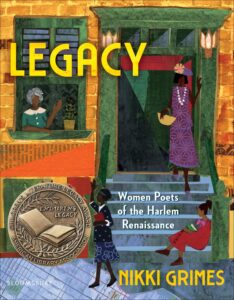
Legacy by Nikki Grimes

This is more of a collection of poems and visual art than a novel in verse, but I’m including this book because it’s become one of my new favorites. Using the Golden Shovel poetry form, Grimes takes one line or short poem from a Black female Harlem Renaissance poet and uses it to make her own poem. The book itself is formatted so you read the Harlem Renaissance poem first and then the poem it inspired Grimes to write. Each set of poems is also accompanied by visual art by Black women, including Vashanti Harrison and Shada Strickland. As a whole, the poetry and illustrations work together to bridge the past and present.

Catching a Storyfish by Janice N. Harrington

A novel in verse aimed at a middle school audience, this book tells the story of Keet, a young Black girl from Alabama who loves talking and tellling stories. When she moves away, she isn’t sure how to cope until a fishing trip with her grandfather teaches her how to listen before speaking. However, her grandfather suddenly has a stroke and that makes him feel further away from her. In order to reconnect with him, Keet must find her voice again through stories.

Long Way Down by Jason Reynolds

In an elevator, a teenaged Black boy named Wil is on the way down with a gun in his waistband to take revenge for his older brother, who was murdered by someone in the neighborhood. But each time the elevator stops on a new floor, Wil is visited by ghosts who make him question everything he thinks he knows about revenge and emotions. Through a true-to-life cast of characters and powerful verse, Reynolds delivers a poignant tale of gun violence through both its victims and those left behind. This book lingered in my mind long after I read it because of how skillfully Wil’s conscience is represented and questioned through the characters and words.

Solo by Kwame Alexander

Filled with both music and poetry, Solo features the tale of Blade, the son of a washed-up rock star named Rutherford. When Rutherford’s legacy threatens to overwhelm him, Blade finds a letter about his parentage that leads him to Ghana. From there, he undergoes a journey to find out who he can become outside of his father’s influence and whether he can live up to the expectations he has for his life. I really appreciated how Alexander wove together various cultural influences, such as rock music and Ghanaian culture, to shape Blade’s character development.

Every Body Looking by Candice Ihoh

A coming-of-age story starring a first-generation Nigerian American female protagonist, this book explores the impact of heavy familial expectations and the desire to break free and express your true self. When Ada attends a HBU, she finds herself following her passion for dance while exploring her sexuality. At the same time, she also comes face to face with past issues as she tries to claim ownership over her body and future. It is rare to see a YA novel set in a college space, so finding one that is also in verse is extra special.

The Afro YA promotes black young adult authors and YA books with black characters, especially those that influence Pennington, an aspiring YA author who believes that black YA readers need diverse books, creators, and stories so that they don’t have to search for their experiences like she did.

Latonya Pennington is a poet and freelance pop culture critic. Their freelance work can also be found at PRIDE, Wear Your Voice magazine, and Black Sci-fi. As a poet, they have been published in Fiyah Lit magazine, Scribes of Nyota, and Argot magazine among others.